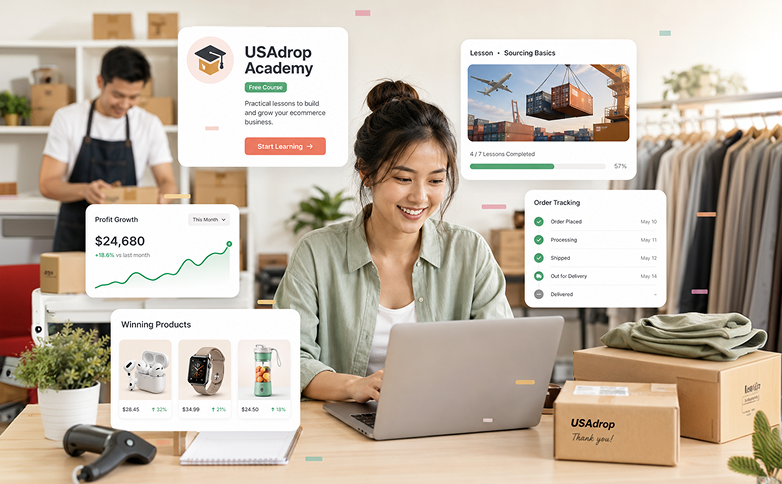
When looking for the best dropshipping suppliers, start with what you want to sell and the services your store needs. For low-cost product testing, compare AliExpress sellers, but make sure you check the shipping time and product quality. Spocket is worth considering if you want suppliers in the US and Europe, while USAdrop offers all-in-one sourcing and fulfillment for Shopify and TikTok Shop stores.
That’s why we’ve put together this list of 10 suppliers to consider in 2026. Each one has its own strengths, from product selection and industry focus to fulfillment services and store management tools. Use this list to find the option that best fits your business.

Compare the 10 options
|
Supplier or platform
|
Service model
|
Best for
|
Price Plan
|
|
AliExpress, optionally managed through DSers
|
Marketplace of individual sellers
|
Low-cost product testing
|
DSers Basic: Free; Advanced: $19.90/month; Pro: $49.90/month
|
|
CJdropshipping
|
Sourcing and fulfillment platform
|
Custom sourcing beyond a ready-made catalog
|
Free core plan; optional paid plans start at $15.99/month
|
|
USAdrop
|
All-in-one platform
|
All-in-one sourcing and fulfillment on Shopify and TikTok Shop
|
Free; Pro: $29.99/month; Plus: $45.99/month
|
|
Spocket
|
Supplier marketplace
|
Prioritizing US/EU supplier locations
|
Starter: $39.99/month; Pro: $59.99/month; Empire: $99.99/month; Unicorn: $299.99/month
|
|
Zendrop
|
Dropshipping and fulfillment platform
|
Automating a Shopify store’s order workflow
|
Free browsing; Beginner: $29/month; Pro: $49/month; Plus: $79/month
|
|
Syncee
|
Dropshipping and wholesale marketplace
|
Building an international multi-brand catalog
|
Free browsing; Beginner: $29/month; Pro: $49/month; Plus: $79/month
|
|
Shopify Collective
|
Shopify retailer-to-supplier network
|
Reselling products from other Shopify brands
|
Free for eligible stores with an active Shopify plan
|
|
Printful
|
Print-on-demand fulfillment service
|
Branded print-on-demand merchandise
|
Free; Growth: $24.99/month; Enterprise: Custom pricing
|
|
Printify
|
Network of print providers
|
Comparing print providers for custom products
|
Free; Premium: from $39/month or $299/year; Enterprise: Custom pricing
|
|
SaleHoo
|
Supplier directory and research service
|
Researching vetted wholesale and dropshipping suppliers
|
Starter: $9/month billed annually or $299 lifetime; Pro: $49/month billed annually or $1,699 lifetime
|
How to Choose a Reliable Dropshipping Supplier?
First, be clear about what you sell—or what you want to sell. Think about where your customers are, which sales channels you use, and what you need from a supplier. Are you testing a new product, or do you need a partner that can handle regular orders as your business grows? Once you know this, it will be much easier to choose a supplier that fits your business.
Here we’ve summarised six aspects for you to check before selecting a supplier for your dropshipping business.
-
Product, market, and business fit: Start with the basics. Does the supplier offer the products and variants you need? Are its stock levels accurate? Can it help source products that are not already listed? Also make sure it can ship to your target countries, work with your sales channels, and support your business whether you are testing products or handling more orders.
-
Quality, reliability, and support: Check the product quality before you start selling. You should also ask how quickly the supplier solves problems and who will handle incorrect, damaged, lost, or returned orders.
-
Fulfillment and delivery: Verify the actual ship-from location and available stock. Record processing and transit separately, then check tracking quality, delivery coverage, and how delays or stockouts are communicated.
-
Total operating cost: Do not compare suppliers based only on the product price. Add shipping, duties and taxes, subscription or service fees, packaging, storage, minimum-order requirements, and possible return or replacement costs.
-
Integration and automation: Make sure the supplier can connect with your store. Test how products, prices, inventory, orders, fulfillment updates, and tracking information are synced. You should also know who will help when the automated process does not work as expected.
-
Branding and scalability: If you want to build your own brand or grow your order volume, check whether the supplier offers private labeling, custom packaging, inserts, print-on-demand, warehousing, restocking, or wholesale services. Ask about minimum quantities, setup costs, lead times, and how many orders the supplier can handle.
Start with the requirements you cannot compromise on. Then compare each supplier based on product, variant, destination, packaging, and service level standards. Before making a final decision, order samples and place test orders. It is also a good idea to keep a backup supplier for your most important products.
The best supplier is not always the one with the lowest price or the largest catalog. It is the one that fits your business, delivers orders reliably, solves problems quickly, and can continue supporting you as your store grows.

The 10 Best Dropshipping Suppliers for 2026
We compared these platforms by looking at shipping reliability, product quality, automation tools, and customer support. Here’s what you should know before choosing one.
1. AliExpress

AliExpress is a good place to start if you want to test products without committing to one supplier. Since it is a marketplace, you may find several sellers offering the same or similar products. Their prices, ratings, shipping options, and service can be different, so always check the individual seller and the exact product variant.
If you use AliExpress for dropshipping, DSers can make supplier comparison and product mapping easier. Its Supplier Optimizer helps you compare sellers based on price, sales, and ratings. Just keep in mind that DSers is a management tool—the AliExpress seller is still responsible for supplying the product.
Strengths: You can compare several sellers and place small test orders before deciding whether a product is worth scaling. DSers can also reduce the manual work involved in finding alternative suppliers, mapping products, and managing orders.
Limitations: Similar photos do not establish identical materials, quality, or delivery. Check the selected variant, seller, shipping method, and refund terms before listing it.
Best for: Testing a small product range without a long-term supplier commitment.
2. CJdropshipping

CJdropshipping is useful for sellers who need custom product sourcing and broad store integrations. If a product is not available in its catalog, you can submit a sourcing request using a product link, image, or description.
CJ also supports store connections, order syncing, tracking updates, custom packaging, print-on-demand, and warehousing. This gives you a more direct path from finding a product to shipping it to your customers.
Strengths: Broad platform integrations, frequent sourcing requests, and flexible warehouse and shipping options.
Limitations: roducts that are not stocked in a CJ warehouse require additional purchasing or sourcing time. Shipping costs and delivery times vary by product and warehouse.
Best for: Custom product sourcing and fulfillment in one place.
3. USAdrop

If you want one platform to handle most of your dropshipping operations, USAdrop is worth considering. It brings sourcing, warehousing, order fulfillment, and after-sales support together in one place.
The platform is designed mainly for Shopify and TikTok Shop sellers. You can connect your store, automate order processing, request custom products, and work with a personal sales agent. USAdrop also provides specialized payment and fulfillment solutions for Latin American markets.
Strengths: An all-in-one workflow covering sourcing, quality inspection, fulfillment, tracking, branding, and after-sales support. Personal sales agents and Latin American payment solutions are also available.
Limitations: One-to-one sales support is available for customers with 5 or more orders. Orders below this volume are managed via platform support.
Best for: Shopify and TikTok Shop sellers who want an all-in-one dropshipping platform with agent-assisted support.
4. Spocket

Spocket is worth checking if you want to find suppliers based in the US or Europe, especially when your customers are in these regions.
Spocket reviews its suppliers based on factors such as whether they hold their own inventory, meet product standards, and follow their stated processing and shipping times. However, you should still check the location and delivery time of each product before adding it to your store.
Strengths: It helps you find reviewed suppliers, including many based in the US and Europe.
Limitations: Some users report inaccurate stock, slow supplier replies, and generic support responses. Check inventory and test each supplier before promoting a product.
Best for: Finding products from reviewed US and European suppliers.
5. Zendrop

Zendrop is designed for beginners who want to automate order fulfillment and use built-in tools to research and market products. It connects directly with Shopify, TikTok Shop US, Wix, and ClickFunnels.
Paid plans provide automated fulfillment, AI product research, advertising tools, trending product data, and training resources. Zendrop also offers products from China and US-based suppliers.
Strengths: Beginner-friendly automation, AI product and advertising tools, training courses, and access to US-based products.
Limitations: A paid plan is required to link products and process orders. Zendrop does not display actual inventory counts. Products from US suppliers only ship within the United States and do not support custom branding.
Best for: Automating order fulfillment for Shopify stores.
6. Syncee

Syncee is a good option if you want to add products from different brands and suppliers to your store. Its marketplace includes suppliers from the US, Canada, the UK, Europe, Australia, and other markets. It supports both dropshipping and wholesale and provides tools for managing products and orders.
Syncee mainly helps you find and manage existing products from multiple suppliers. It may suit you better if you want to build a multi-brand product catalog rather than ask one sourcing partner to develop a custom product.
Strengths: It offers products from brands and suppliers across several markets, with tools for managing products and orders.
Limitations: Shipping, returns, and product terms vary by supplier. Some suppliers require approval, and certain features need a paid plan.
Best for: Building a multi-brand catalog from international suppliers.
7. Shopify Collective

If you use Shopify and want to sell products from other Shopify brands, you can consider Shopify Collective. Eligible retailers can import products from connected brands into their stores, while the suppliers handle fulfillment. Order and tracking information can also be synced between the two stores.
This is different from sourcing an unbranded product and selling it under your own name. With Shopify Collective, you are adding products from other established brands to your store.
Strengths: You can import products from other Shopify brands while the supplier handles fulfillment. Inventory, orders, and tracking are synchronized.
Limitations: Both stores must meet Shopify’s eligibility requirements. It is designed for reselling branded products, not private labeling.
Best for: Selling products from other Shopify brands.
8. Printful

Printful is a good choice if you want to sell products featuring your own designs. When a customer places an order, Printful prints and ships products such as clothing, accessories, and home items for you.
You can also add branding to eligible labels and packaging. However, custom packaging is not available for every product or fulfillment location. Your packaging must be approved, and enough packaging stock must be available at the correct facility.
Strengths: It prints and fulfills custom products after each order, with no minimum order quantity. Branding options are also available.
Limitations: Production time comes before shipping. Custom packaging is only available at supported facilities and includes extra requirements and fees.
Best for: Selling your own designs through one print-on-demand provider.
9. Printify

Printify connects you with a network of print providers instead of using only one fixed manufacturer. This gives you more choices when creating and selling custom-printed products.
Each provider may offer different locations, product prices, shipping fees, variants, print areas, and extra features. So do not compare the product alone. You should also compare the providers and choose the one that fits your product, customers, and budget.
Strengths: You can compare print providers by location, price, product options, and shipping costs.
Limitations: Product quality, production time, and shipping vary by provider. Samples are not free, so test your chosen provider before selling.
Best for: Comparing print providers for custom products.
10. SaleHoo

If you are not sure where to find suppliers, SaleHoo can be a useful starting point. Its directory helps you research and contact potential wholesalers and dropshipping suppliers.
However, the suppliers listed on SaleHoo do not share one pricing, shipping, or fulfillment system. You still need to discuss these details with each supplier. SaleHoo also offers different tools and services, so make sure you understand whether you are paying for directory access or using one of its separate dropshipping products.
Strengths: Its directory helps you research and contact reviewed wholesale and dropshipping suppliers.
Limitations: Directory access requires a paid plan. SaleHoo does not fulfill every order, and supplier terms and integrations vary.
Best for: Researching wholesale and dropshipping suppliers.
How to Choose the Right Supplier for Your Store
Start with what your store needs now
-
Testing products: Compare AliExpress sellers. If you need a product sourced with specific features, consider CJdropshipping.
-
Managing everything in one place: Consider USAdrop if you sell through Shopify or TikTok Shop and want sourcing, warehousing, fulfillment, and after-sales support on one platform. Check the requirements for one-to-one support and customization first.
-
Finding US or European suppliers: Use Spocket, but check the supplier location, shipping route, and delivery time for each product.
-
Selling your own designs: Choose Printful if you want one company to print and fulfill your products, or Printify if you want to compare different print providers.
-
Finding suppliers to work with directly: Use SaleHoo to create a shortlist, then contact each supplier to discuss prices and terms.
These are only starting points. Several platforms offer similar services, so choose based on your products, target market, and daily order needs.
Calculate the real cost of each order
Compare the same product, quantity, and delivery destination. Include:
Product cost + shipping + duties and taxes + packaging + platform or service fees + expected return and replacement costs.
Also include any upfront costs for samples, artwork, packaging inventory, or stock. The product with the lowest listed price is not always the cheapest overall. A free account does not mean shipping and fulfillment are free.
Test the full process before you scale
-
Get a detailed quote: Confirm the product variant, quantity, shipping location, destination, and packaging.
-
Order a sample: Check the quality, size, labels, and packaging against the product listing.
-
Place a test order through your store: Check inventory updates, order transfer, payment, tracking, and customer notifications.
-
Ask what happens when something goes wrong: Confirm how the supplier handles out-of-stock products, incorrect or damaged items, lost packages, and returns.
-
Start small: Compare the actual processing and delivery times with the supplier’s estimates before placing more orders.
Track processing time and shipping time separately. Customized and made-to-order products may need extra production or packaging time. Use the actual shipping route to set realistic delivery times for your customers.
Common Dropshipping Mistakes to Avoid
Don’t pick suppliers based on price alone. The cheapest supplier usually has the slowest shipping, worst quality, or nonexistent support. You’ll lose more money on refunds and lost customers than you save on product costs.
Don’t skip product samples. You need to know exactly what your customers will receive. Order samples before adding products to your store. If quality is bad, find a different supplier.
Don’t ignore customer reviews of suppliers. Other retailers have already tested these platforms. Read reviews. Look for complaints about shipping delays, quality issues, or support problems.
Don’t rely on one supplier. If they run out of stock or go offline, your entire store stops. Have backup suppliers for your best-selling products.
Don’t forget about returns. Make sure you understand the supplier’s return policy before you start selling. If they don’t accept returns, you’re stuck handling it yourself.
What is the best dropshipping supplier for beginners?
First, think about what you want to sell and how much support you need. For low-cost product testing, start by comparing AliExpress sellers, but be aware that product quality and shipping time can vary.
For products with your own designs, compare Printful and Printify. If you want sourcing, quality checks, and fulfillment in one place, USAdrop is worth considering. Whichever supplier you choose, order a sample and check the total cost and shipping route first.
Which dropshipping suppliers offer fast US delivery?
If fast US delivery is important, first check where the exact product is stocked. USAdrop estimates 2–5 working days for eligible products already available in a US warehouse. Products sent from its main warehouse to the US are estimated to take 6–13 days. USAdrop separately lists 1–3 business days for order processing.
Spocket, CJdropshipping, and Zendrop also offer US-based suppliers or fulfillment options, but not every product ships from the US. Always check the product variant, available stock, warehouse, and full delivery time before listing it.
Is USAdrop right for my store?
If you sell on Shopify or TikTok Shop and want to keep sourcing and fulfillment in one place, USAdrop could be a good fit. It also supports quality checks, warehousing, branding, and after-sales service.
One-to-one sales support starts at five orders. Sellers with fewer orders can still manage fulfillment through the platform. If you only want a large marketplace to browse products, AliExpress may be simpler.
Can I start without buying inventory in bulk?
Yes. With USAdrop, you can start with single-item fulfillment. Print-on-demand products are made after a customer places an order, so you do not need to buy finished products in bulk.
But be aware that you still need to pay for the product, customization, fulfillment, shipping, and samples. Regular sourced products may require reserved stock. Custom packaging and private labeling may also require minimum quantities, setup fees, or packaging stock. Confirm these details before you start selling.
What’s the difference between USAdrop, AliExpress, SaleHoo, and print-on-demand platforms?
They each serve a different purpose. AliExpress is a marketplace where you compare individual sellers. SaleHoo helps you find and contact suppliers. Printful and Printify mainly focus on custom print-on-demand products.
USAdrop is for sellers who want sourcing, quality checks, warehousing, fulfillment, branding, and after-sales support in one place. It can be a good option if you sell on Shopify or TikTok Shop and do not want to manage several suppliers and tools yourself. Still, check the product cost, shipping time, and delivery route before you decide.
Conclusion
The best dropshipping suppliers are not always the biggest or the cheapest. Start with what you want to sell, where your customers are, and what support you need. Then compare the product quality, shipping route, total cost, and customer support. You do not need to use all ten platforms—choose one or two that fit your store and place a test order first.
If you want sourcing and fulfillment in one place for Shopify or TikTok Shop, USAdrop is worth considering. Check USAdrop’s fulfillment service and provide your product variants, target countries, and packaging requirements to get a quote. The right supplier is the one that can deliver your orders reliably and support your store as it grows.