Remember the dropshipping gold rush? A winning product, some basic Facebook ads, and a Shopify store could build a six-figure business almost overnight. That era is over.
In 2026, the ecommerce landscape has fundamentally shifted. Competition isn’t just fiercer—it’s smarter. Ad costs have soared, customer expectations have skyrocketed, and the sheer noise in the market has made traditional product-testing cycles obsolete.
The pain point is no longer finding AI tools for dropshipping, but integrating them.
The merchant drowning in 12 different browser tabs—one for product research, another for supplier communication, a third for ad creation, a fourth for customer support—is watching their margins evaporate in operational friction.
This is where a seismic shift is occurring. Winners are no longer defined by the individual apps they use, but by the systemic advantage they build.
The future belongs to those who stop thinking in tools and start thinking in unified ecosystems—where AI-driven insights flow seamlessly into automated fulfillment, where creative generation is tied directly to supply chain capabilities, and where every customer interaction is informed by logistics data.
This guide isn’t about listing 100 AI tools. It’s about revealing the new architectural blueprint for scalable ecommerce: the move from fragmented workflows to integrated ecommerce infrastructure.
By the end, you’ll understand why the real competitive edge in dropshipping in 2026 is no longer a secret product source, but a seamlessly connected system.
Why Traditional Dropshipping Models Are Breaking Down
The old playbook is crumbling under its own weight. Here’s why the isolated, manual approach is hitting a hard ceiling:
Skyrocketing Ad Costs & Plummeting ROAS
Customer acquisition costs are at an all-time high. Blasting generic ads to broad audiences is a fast track to burning cash. The “spray and pray” method is financially unsustainable without hyper-targeting and creative optimization that only AI ecommerce tools and deep data integration can provide.
The Fragmented Supplier Nightmare
Juggling 5–10 AliExpress suppliers—each with different communication standards, shipping times, and quality levels—destroys brand consistency and customer trust. One bad shipping experience from a single supplier can tank your store’s reputation.
Glacial Product Testing Cycles
Manually sourcing samples, creating content, and launching tests can take weeks. In 2026’s fast-paced trend cycles, by the time you validate a product, the trend has often peaked. The window of opportunity is now measured in days, not months.
Unacceptable Customer Experience
Long shipping times, zero brand cohesion, and generic tracking updates are no longer tolerated. Customers expect Amazon-like reliability with direct-to-consumer brand personality. Traditional dropshipping fails on both fronts.
The Brand Differentiation Desert
When anyone can source the same product from the same catalog, competition devolves into a race to the bottom on price. Without a unique value proposition built through consistent branding and customer experience, margins evaporate.
🔍 The Core Problem
These aren’t isolated issues. They are symptoms of a fragmented workflow. Each bottleneck amplifies the others. The solution isn’t to work harder on each individual piece—but to re-engineer the connections between them.
Core Roles of AI in Modern Dropshipping
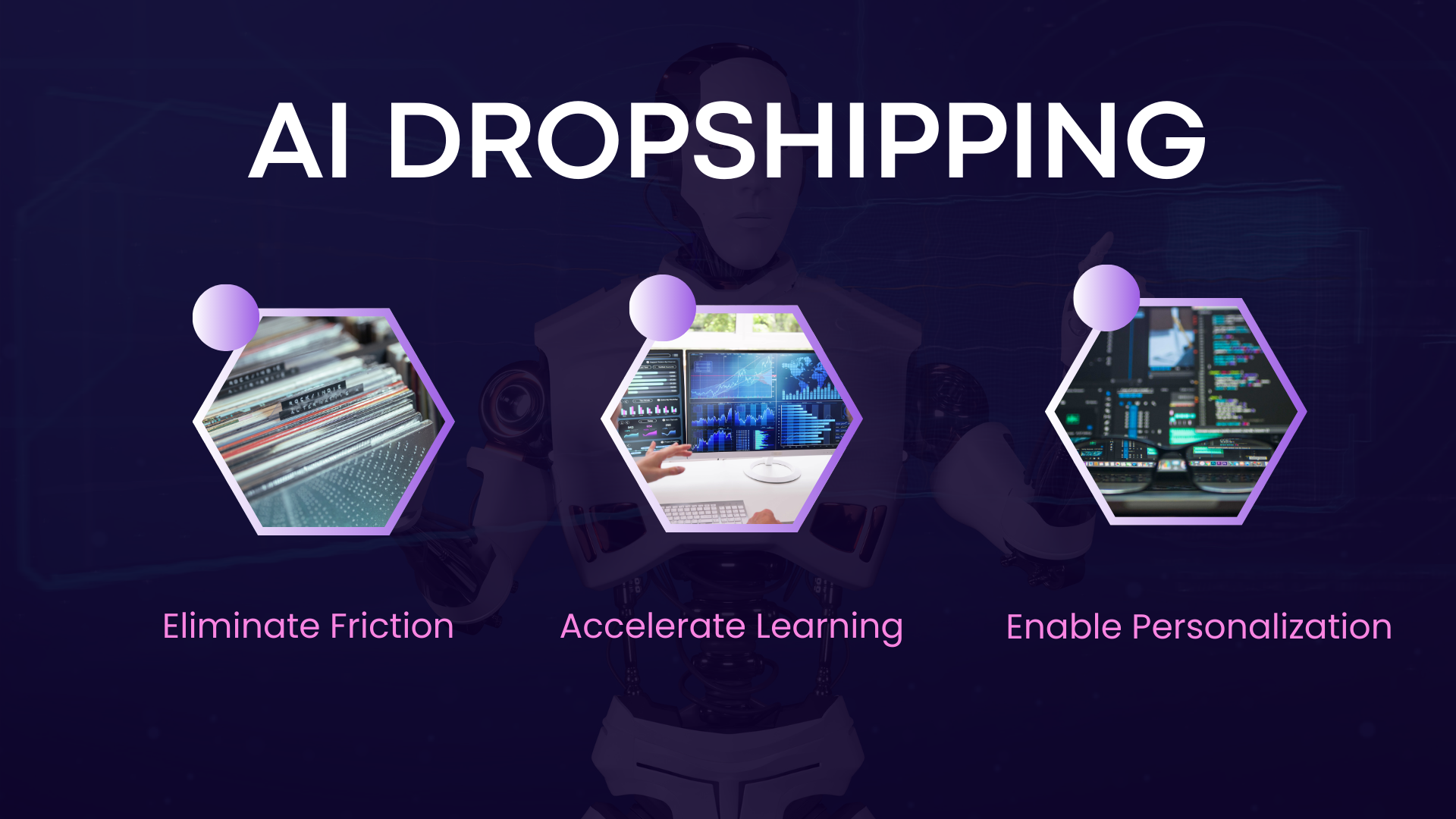
AI is not a magic bullet; it’s the connective tissue. Its role is to eliminate friction, accelerate learning, and enable personalization at scale across four critical domains.
AI-Powered Product Discovery: From Guessing to Knowing
The Problem
You’re relying on gut feeling and manual trend-spotting on social media—a slow and error-prone process.
The AI Solution
Tools like Jungle Scout Cobalt, Adpsyllama, or Alpha use machine learning to analyze search volume, social sentiment, competitor saturation, and historical success patterns. They predict winning products before they trend, calculating potential profit margins after estimated ad spend and shipping costs.
💡 The Hidden Logic
An AI product recommendation is only as good as the supply chain that supports it. Predicting a winner for a fragile, poorly manufactured item with 45-day shipping is a fast track to negative reviews.
True advantage comes from coupling AI-driven insights with a reliable, agile sourcing and fulfillment system that can capitalize on opportunities with speed and quality.
AI Content & Video Production: Scaling Creativity
The AI Solution
Tools like Pictory, InVideo AI, and Synthesia generate video ad scripts, B-roll, and presenter-led videos in minutes. For static content, Midjourney and DALL·E 3 produce high-impact product mockups and lifestyle imagery.
💡 The Hidden Logic
A brilliant AI-generated ad is worthless if the product arrives looking completely different or fails after one use.
High-performing ecommerce brands in 2026 create a virtuous loop where AI creative tools are fed by real product samples, reliable quality control, and fast fulfillment data, ensuring the ad promise matches the unboxing reality.
AI Copywriting & Conversion Optimization: The Persuasion Engine
The AI Solution
Platforms like Copy.ai, Jasper, and ChatGPT craft converting product descriptions, email flows, and ad copy. AI-powered CRO tools such as Mutiny or VWO dynamically personalize messaging and run scalable A/B tests.
💡 The Hidden Logic
No copy—no matter how persuasive—can overcome distrust caused by slow shipping, unclear fulfillment, or weak support.
Conversion optimization peaks when AI-driven persuasion, high-quality visuals, and transparent fulfillment align. Trust is the ultimate conversion lever.
AI-Driven Supply Chain & Fulfillment: The Operational Brain
🔥 This is the core of the new architecture.
Traditional dropshipping supply chains are opaque, slow, and inconsistent. Sellers are often the last to know about stockouts or delays.
Modern logistics platforms use AI for predictive inventory forecasting, dynamic routing, and automated quality control—turning fulfillment from a cost center into a competitive advantage.
💡 The Hidden USAdrop Logic
The frontier is no longer AI within logistics, but the full integration of sourcing, quality control, and fulfillment into a single ecosystem.
This marks the shift from managing suppliers to orchestrating a supply chain system.
AI Customer Support & Automation: The Always-On Advocate
Advanced AI support tools like Gorgias AI or Zendesk Answer Bot integrate with order systems to proactively update customers, process returns, and resolve issues using real-time logistics data.
💡 The Hidden Logic
When AI support connects directly to fulfillment data, customer service becomes a brand trust engine, not a cost center.
From Tools to Ecosystems: The New Dropshipping Architecture
The future of scalable dropshipping is not about using more tools—but about building or joining integrated ecosystems.
Fragmented stacks create data silos and operational lag. Integrated systems create continuous feedback loops where data flows freely across sourcing, marketing, fulfillment, and support.
This is the new dropshipping infrastructure.
Business Advantages of Integrated AI + Ecommerce Systems
Hyper-Accelerated Product Launches
Higher ROAS with Lower CAC
Radically Reduced Operational Complexity
Unbreakable Brand Consistency
Effortless Global Scalability
Recommended AI Stack for Dropshipping
Tier 1: Entry-Level AI Toolkit
AI tools automate tasks—but integration and supplier risk remain manual.
Tier 2: Advanced Integrated Workflow
Professional sellers adopt platforms that combine AI insights, product sourcing, quality control, and fulfillment into one system—this is the system advantage in action.
The Future of AI-Driven Dropshipping (2026–2030)
Expect predictive trend creation, autonomous store optimization, self-healing supply chains, and real-time hyper-personalized commerce.
Conclusion: Winning the System Advantage
By 2026, the question is no longer whether AI will be part of dropshipping.
That debate is already over.
The real question is where AI connects to reality.
Insights are easy to generate.
Ads are easy to produce.
What’s hard — and increasingly rare — is a system that can execute those insights at scale, with consistency, speed, and trust.
This is where USAdrop fits into the modern ecommerce architecture.
USAdrop is not another tool added to the stack.
It is the infrastructure layer that connects AI-driven decisions with real-world execution:
Turning product insights into verified sourcing, quality control, and ready-to-ship inventory
Aligning AI-generated creatives with real samples, warehouse-certified assets, and reliable fulfillment
Unifying orders, logistics, and post-purchase communication into a single operational system
In other words, it removes the gap between what your store promises and what your supply chain delivers.
As ecommerce moves from experimentation to system-level competition, the winners won’t be those using the most tools —
but those operating on the strongest foundations.
AI enables growth.
Systems sustain it.
USAdrop exists to be that system.
Ready to move from tools to systems?
Explore how an integrated sourcing and fulfillment infrastructure supports scalable dropshipping in 2026.