
How should your store handle a damaged package to protect both your customer relationships and your bottom line? Discovering a broken item is a frustrating experience for any buyer, and your immediate response can make or break their loyalty. The secret is taking two actions simultaneously: delivering swift relief to the customer while gathering enough evidence to file a successful claim with your carrier or supplier.
Forcing a customer to wait weeks while a carrier investigation drags on is a sure way to trigger negative reviews and chargebacks. A much smarter approach is to take immediate control of the claim, offer a clear and sensible resolution right away, and log the issue to prevent similar packaging failures in the future. Below is a practical five-step process to help your team manage package damage claims seamlessly without losing money.
Step 1: Document the Damage Immediately
Ask the customer for evidence in one clear message. A useful evidence set includes:
- A full photo of the outer package from more than one side.
- A close photo of the dent, tear, puncture, water mark, or crushed corner.
- A photo of the shipping label with the tracking number visible.
- Photos of the internal cushioning and how the item sat inside the box.
- A clear photo or short video showing the product damage or failed function.
- The order number, delivery date, and a short description of what happened.
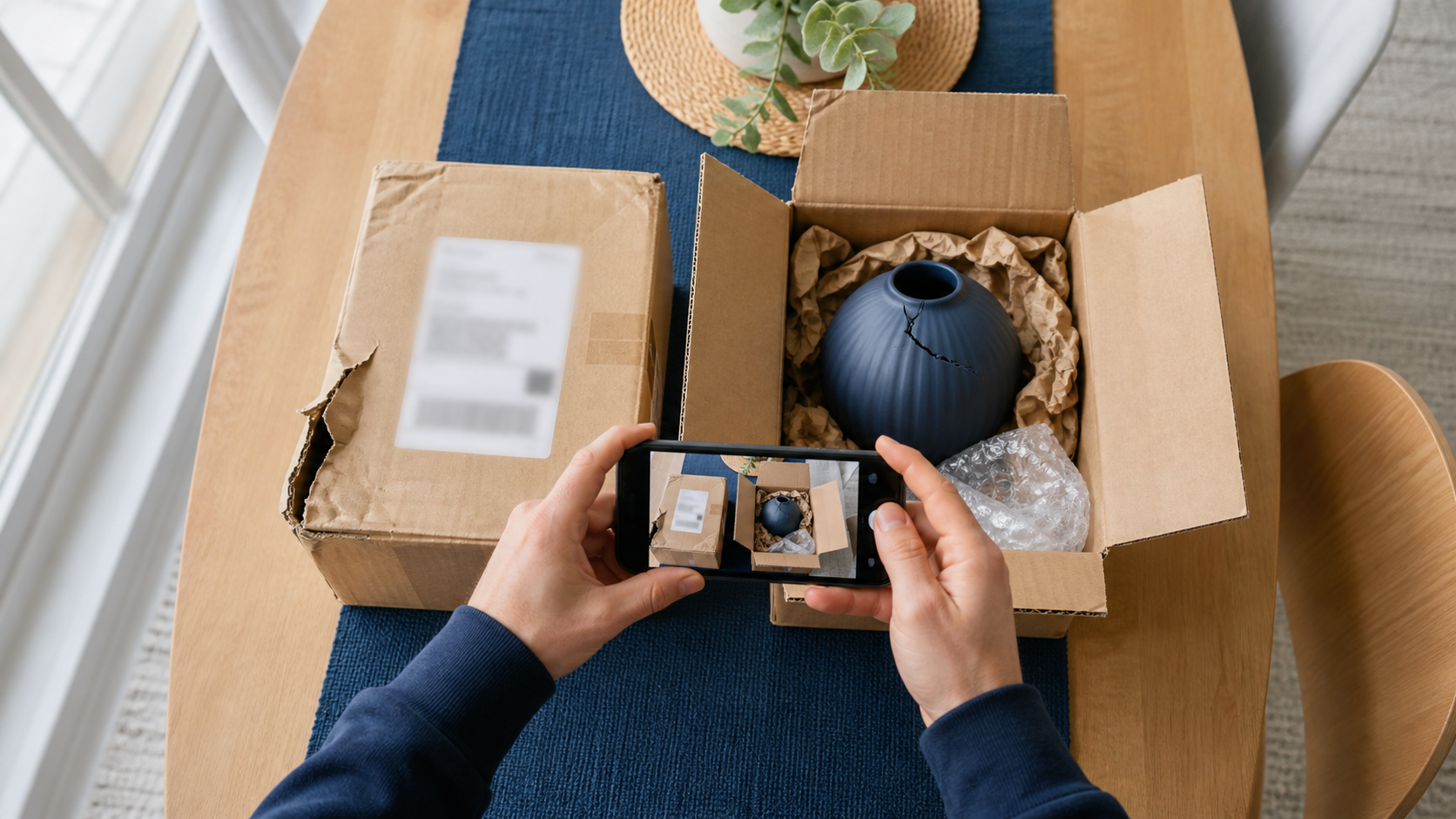
Tell the customer to keep the product, box, label, and packing materials until you confirm they can be discarded. UPS’s official claim guidance says damaged contents and packaging should be retained, and its photo process may request the damaged item with its internal packing, the label, the outside of the box, and box dimensions. FedEx also advises keeping original packaging until the claim is resolved.
Do not demand unsafe handling. If glass, a battery, a chemical product, or another hazardous item is leaking or broken, ask the customer to stop and follow the product and local disposal instructions. Photos should never matter more than safety.
Step 2: Check Responsibility and Deadlines
Evidence tells you what happened; the order record tells you who must act. Review the product listing, selected variant, warehouse, packing instruction, shipping line, tracking scans, delivery photo, declared value or insurance, and the policies that applied when the order was placed.
Use this quick responsibility check:
| Finding | Likely path | First record to check |
|---|---|---|
| Product defect, intact box | Supplier or manufacturer | Sample and quality specification |
| Crushed box and broken item | Carrier, packer, or both | Packing photos and carrier rules |
| Wrong item or missing part | Supplier or warehouse | Pick list and packing record |
| Cosmetic box damage only | Store policy decision | Listing and damage definition |
| No delivery | Lost-package process | Tracking history and address |
“Likely” is deliberate. A carrier may reject a claim when the carton, cushioning, or label did not meet its rules. A supplier may accept a defect claim but not transit damage. The party that bought the shipping label may also be the party required to file. Check the actual terms instead of assuming the customer can open the claim.
Time limits vary by supplier, route, carrier, country, service level, and insurance plan. Record the earliest possible deadline in the support ticket and work backward. Your customer-facing dropshipping return policy should leave enough time for your team to collect evidence and submit it upstream.
Step 3: Resolve the Customer Request
Reply as the store that accepted the order. Do not send the customer to an unknown overseas supplier or ask them to negotiate with a carrier before you provide support.
A strong first response does four things: acknowledges the damage, apologizes for the poor arrival condition, asks for a specific evidence set, and gives a time for the next update. Avoid admitting a cause before you have reviewed the package. “We are checking whether the damage occurred during packing or transit” is accurate; “the courier broke it” may not be.
Once the evidence is sufficient, choose the remedy that fits the product and your published policy:
- Send a replacement when the item is still wanted, stock is available, and the new delivery time is acceptable.
- Issue a refund when the item is unsafe, unusable, time-sensitive, or the customer no longer wants to wait.
- Offer a partial refund only when the item remains usable and the customer freely agrees. Do not use it to pressure someone into keeping an unsafe product.
- Arrange a return only after confirming the address, authorization, label, cost owner, and whether the item is safe to ship.
For a low-cost item, return postage can exceed the recoverable value. A returnless refund or replacement may cost less, but account for fraud risk and local consumer rules. For expensive, serialized, repairable, regulated, or insured products, obtain approval before telling the buyer to discard anything.
Step 4: File the Shipping Claim
The customer remedy and the reimbursement claim are related, but they are not the same workflow. Help the customer according to your obligations and policy, then recover the eligible cost from the supplier, fulfillment partner, carrier, or insurer.
Build one claim packet with the order number, SKU and variant, tracking number, ship and delivery dates, customer statement, package and product photos, packing instructions, proof of value, invoice, and the remedy you gave the customer. Save the original files rather than screenshots compressed by a chat app.
Submit the claim through the channel named in the applicable policy. If a supplier managed the label, send the packet to the supplier or fulfillment partner and ask who owns the carrier case. If your store bought the label, open the carrier or insurance claim directly when eligible. Parcel shipping fundamentals can help your team identify the service, package measurements, and handoff records that a claim may require.
Give every case a claim ID, owner, next-action date, and status such as waiting for customer, submitted, more evidence requested, approved, denied, or closed. Never promise that a carrier will reimburse the retail sale price. Coverage, proof of value, exclusions, packaging compliance, and declared-value rules can limit or prevent payment.
Step 5: Prevent Repeat Package Damage
A refund closes the ticket. A root-cause record protects the next order.

Tag each incident by SKU, supplier, warehouse, carrier, route, box size, damage type, and likely cause. Review damage rate per 100 delivered orders, not just the number of complaints. Three broken units from 30 deliveries need faster action than five from 10,000.
Then test one change at a time. Use a right-sized carton, add corner or void protection, isolate hard parts, seal liquids, reinforce weak closures, or move a fragile SKU to a different shipping line. Order a new sample through the same warehouse and route your customers receive. A premium sample sent by another courier proves little about the normal fulfillment path.
Ask for pre-dispatch photos when the item or packaging has changed, and keep an approved packing reference by SKU. A defined product quality check helps separate manufacturing defects from transit damage. When repeated failures come from poor handoffs or inconsistent warehouse work, assess whether a 3PL dropshipping setup would give you better inspection, packing, and claim records.
Set escalation triggers before the next incident: pause a SKU after two severe safety failures, review packaging after a stated damage-rate threshold, and stop a route when evidence points to repeated mishandling. The exact threshold should reflect item value, volume, risk, and margin.
Damaged Package Response Template
Use this as a starting point and adjust it to your policy:
Hi [Name], I am sorry your order arrived damaged. Please send clear photos of the full outer box, the damaged area, the shipping label, the internal packaging, and the item itself. Keep the item and all packaging for now, as they may be needed for inspection. We will review the evidence and update you by [time/date] with the next step. If the item is unsafe to handle, please stop and tell us immediately.
Do not promise a refund, replacement, return label, or claim approval until you have checked what the order and policy support. You can still be empathetic and precise without making an unsupported commitment.
Damaged Package FAQ
Who should file the carrier claim?
The party that purchased the label or holds the carrier account often files, but rules vary. Check the label record, supplier agreement, carrier terms, and insurance policy before assigning ownership.
Should customers throw away damaged packaging?
No, not until the claim owner confirms it is safe to do so. Carriers may request the box, cushioning, label, contents, photos, dimensions, or an inspection.
Is a damaged box enough for a refund?
Not always. If the product works and only the shipping carton is marked, the remedy depends on the listing, store policy, supplier terms, and applicable consumer rules.
Refund or replacement: which is better?
Replacement suits a customer who still wants the item and accepts the new delivery time. Refunds are often better for unsafe, unusable, seasonal, or urgently needed products.
How long do damage claims take?
There is no universal timeline. Carrier review, inspections, missing evidence, cross-border handoffs, and supplier response times can all change the result, so give customers a dated update rather than a payout promise.
Create a saved evidence request, response template, and claim checklist in your support system today. The next damaged package should become a controlled case with an owner and deadline, not a long email thread that nobody can audit.