Artificial intelligence (AI) is rapidly reshaping the global ecommerce ecosystem, and AI dropshipping is emerging as one of the most transformative business models within this shift. By 2026, AI will move beyond incremental efficiency gains and become a core driver of how dropshipping businesses discover products, acquire customers, manage pricing, and fulfill orders at scale.
From AI product research and dropshipping automation to dynamic pricing, personalized shopping experiences, and smart fulfillment, AI is no longer an optional upgrade—it is becoming foundational to profitable and sustainable dropshipping operations.
This article explores the most important AI dropshipping trends for 2026, key predictions for the future of AI in ecommerce, and what sellers should focus on next to stay competitive.
AI Is Turning Dropshipping From Reactive to Predictive
Traditional dropshipping has long been reactive by nature. Sellers often identify
winning products after trends peak, optimize ads only after performance declines,
and address customer issues once complaints appear.
AI-powered dropshipping fundamentally changes this approach byenabling predictive decision-making.
By 2026, AI systems will be able to analyze massive datasets from social media,search engines, and online marketplaces, forecast product demand weeks or monthsin advance, detect pricing, logistics, and customer experience risks before theyimpact performance, and predict seasonal demand fluctuations to optimize inventoryproactively.
- Analyze massive datasets from social media, search engines, and online marketplaces
- Forecast product demand weeks or months in advance
- Detect pricing, logistics, and customer experience risks before they impact performance
- Predict seasonal demand fluctuations and optimize inventory proactively
This shift transforms dropshipping into a predictive ecommerce model, allowing sellers to move faster, reduce risk, and maximize profit margins.
AI Product Research Will Become the Industry Standard
Product research remains the foundation of successful dropshipping, and AI product research tools are rapidly replacing intuition-based decision-making.
With AI, sellers can:
- Identify emerging trends before markets become saturated
- Automatically evaluate competition levels and entry difficulty
- Predict conversion potential and profit margins before launch
- Analyze historical sales data and seasonal patterns
- Discover high-growth product categories across multiple regions
By 2026, AI product research will no longer be a competitive advantage—it will be a baseline requirement. The real differentiator will be how quickly sellers can act on these insights through sourcing and fulfillment.
Dropshipping Automation and Self-Optimizing Marketing
Dropshipping automation is evolving beyond task execution into continuous optimization. AI-driven marketing systems will increasingly manage campaigns with minimal human input.
Key capabilities include:
- Automatically generating and optimizing ad creatives and copy
- Launching, testing, scaling, and pausing campaigns autonomously
- Dynamically reallocating budgets based on real-time ROI
- Monitoring competitor strategies and adjusting campaigns proactively
- Segmenting audiences for highly personalized targeting
However, even the most advanced AI marketing cannot overcome poor post-click experience. Shipping speed, order accuracy, and fulfillment reliability remain critical to conversion rates and customer lifetime value.
AI Customer Support as a Growth Lever
In AI ecommerce, customer support is shifting from a cost center to a strategic advantage.
By 2026, AI chatbots and virtual assistants will handle most customer interactions, including:
- Real-time order and shipping updates
- Multilingual support for global ecommerce markets
- Personalized responses based on customer history
- Proactive issue detection to reduce refunds and chargebacks
As customer expectations for instant responses grow, accurate fulfillment and logistics data will become essential to effective AI customer support.
Smart Inventory, Dynamic Pricing, and Risk Management
Smart fulfillment will play a central role in AI dropshipping success.
AI will enable sellers to:
- Predict inventory needs and avoid stockouts or overstocking
- Adjust prices dynamically based on demand, competition, and market signals
- Identify supply chain risks early and recommend alternatives
- Continuously evaluate supplier reliability and delivery performance
Execution speed will separate top performers from the rest. Businesses that can implement AI-driven decisions quickly will gain a measurable advantage in margin control and operational stability.
Personalized Shopping Experiences Will Be the Default
Personalized Shopping Experiences Will Be the Default
By 2026, personalization will no longer be optional in AI ecommerce.
AI enables:
- Personalized product recommendations based on browsing and purchase behavior
- Customized email marketing, push notifications, and retargeting
- Dynamic storefront content that adapts in real time to user intent
To deliver true personalization, fulfillment must be just as reliable as the front-end experience. Accurate inventory data, consistent product quality, and predictable shipping are essential to meeting customer expectations.
Advanced Analytics and Continuous Optimization
One of the most powerful aspects of AI dropshipping is its ability to drive continuous optimization.
AI systems can:
- Monitor marketing, product, and fulfillment performance in real time
- Provide predictive recommendations for pricing, inventory, and ads
- Analyze customer sentiment to uncover improvement opportunities
- Generate actionable reports that support scalable decision-making
When analytics and execution are aligned, dropshipping businesses can move seamlessly from insight to action.
Why Fulfillment Remains the Foundation of AI Dropshipping
Despite the rapid rise of AI tools, fulfillment remains the ultimate differentiator in dropshipping.
Successful AI-driven dropshipping businesses require:
- Stable and scalable supplier networks
- Fast, predictable order processing and shipping
- Transparent logistics with real-time tracking
- Seamless integration with ecommerce platforms and AI systems
Without reliable fulfillment infrastructure, even the best AI strategies fail to deliver results.
Preparing for AI Dropshipping in 2026
As AI becomes the foundation of modern dropshipping, success in 2026 will belong to sellers who build systems—not just stacks of tools.
The most resilient businesses will:
- Use AI to anticipate trends and guide data-driven decisions
- Invest in automation that scales without sacrificing control
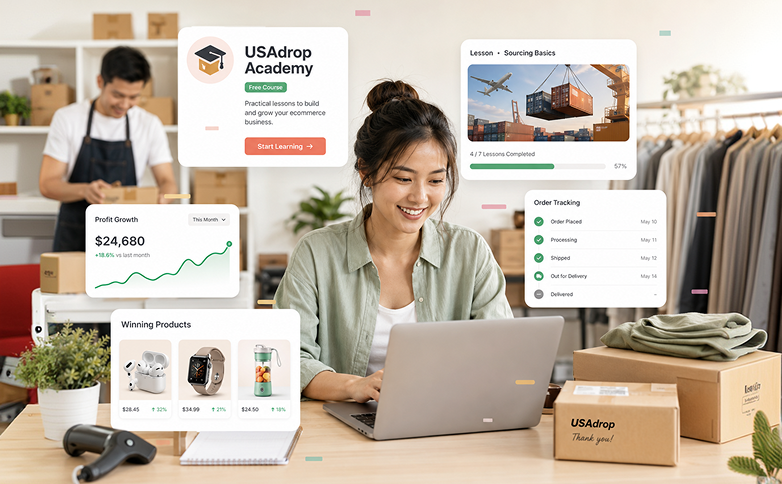
USAdrop’s end-to-end automation system covers sourcing → quality inspection → warehousing → packaging → fulfillment, allowing sellers to scale operations without worrying about complex processes. The system is flexible and fully controllable, enabling sellers to customize logistics, packaging, and inventory strategies while maintaining full brand control.
Prioritize customer experience and fulfillment reliability
USAdrop provides reliable and efficient order fulfillment services, including fast shipping, accurate tracking, and responsive after-sales support. Whether serving new customers or returning buyers, sellers can ensure an exceptional shopping experience, improving customer satisfaction and repeat purchase rates.
- Continuously optimize operations through analytics and feedback
For sellers preparing for this future, platforms that combine global sourcing, fast fulfillment, and system-level integrations will quietly become strategic advantages. Solutions like USAdrop help bridge the gap between AI insights and real-world execution, enabling sellers to scale with confidence as AI reshapes ecommerce.
Final Thought
The future of AI dropshipping is not about who uses the most tools—it’s about who builds the most cohesive system.
By 2026, winning dropshipping businesses will be predictive, automated, and execution-driven from end to end.
AI is already changing the rules.
The question is no longer whether to adopt AI—but whether your operations are ready to support AI-driven growth.