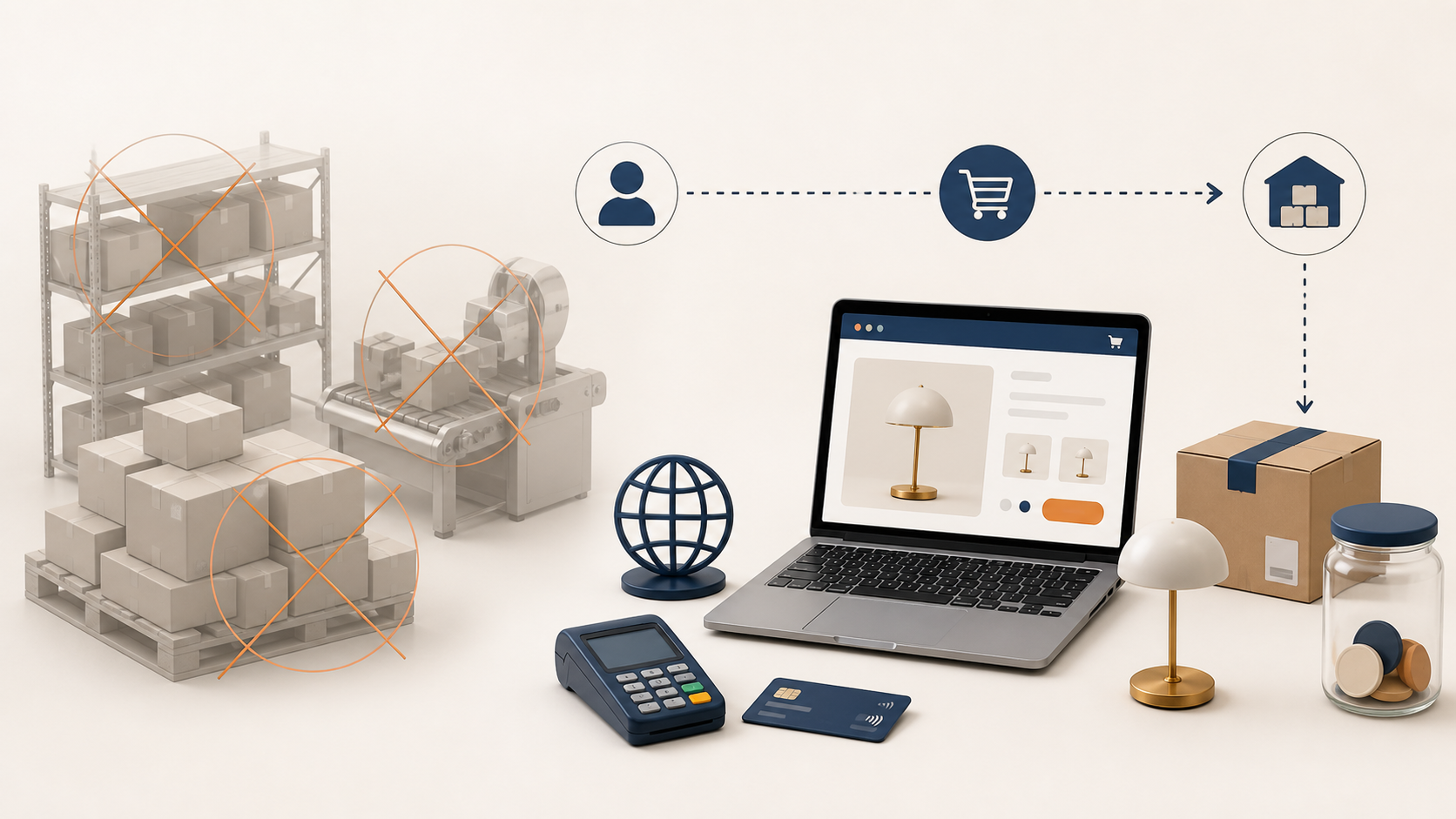
Can you really start dropshipping without buying inventory, renting a warehouse, or paying a large setup fee? Yes—but “free dropshipping” does not mean every part of the business costs nothing. It means removing the biggest traditional retail expenses and paying for products only after customers order. The practical goal is to launch with minimal upfront costs, protect your cash, and spend only when a step helps you validate or fulfill real demand.
We will explain which costs you can avoid, which ones you should plan for, and how to build a lean dropshipping business in 2026 without confusing a low-cost model with a risk-free one.
What Free Dropshipping Really Means
In a traditional retail business, you may pay for stock, storage, packaging equipment, and staff before making your first sale. Free dropshipping changes that sequence. You list products in your store first, then purchase them from a supplier after a customer has paid you.
With USAdrop’s dropshipping service, sellers can start without minimum order quantities, inventory purchases, or warehouse management fees. USAdrop also offers a Free membership plan at $0 per month, with plan limits on services such as product imports, sourcing requests, and monthly orders.
That setup can remove several large upfront expenses, but you still operate a real business. Product and shipping costs become due when orders arrive. Payment processing, returns, taxes, samples, a domain, or a storefront may also require cash. A more accurate definition is:
Free dropshipping is an inventory-light way to validate demand before committing significant capital—not a promise that every business expense will be zero.
Free Dropshipping Costs You Can Avoid
The strongest advantage of dropshipping is not a free logo or trial. It is the ability to avoid tying cash to products that may never sell.
Bulk inventory
You do not need to order cartons of every product before testing it. Instead, publish a focused selection and fulfill units as customers buy. This reduces dead-stock risk and lets you replace weak products quickly.
Private warehousing
You can avoid leasing storage space and buying shelving, scanners, or packing equipment. Your supplier handles inventory and order processing, while you focus on the storefront and customer acquisition.
Minimum order quantities
No-MOQ sourcing allows a new store to test a product with individual customer orders instead of committing to a large batch. This is particularly useful when demand is uncertain.
A large product catalog
Starting with hundreds of listings creates extra design, copywriting, and management work. A lean free dropshipping store can begin with five to ten products serving one clear customer need.
Free Dropshipping Costs You Still Need
A minimal budget works only when it includes the costs that keep orders moving. Hiding these expenses produces bad pricing and cash-flow surprises.
| Cost | Pay before the first sale? | Lean approach |
|---|---|---|
| Inventory in bulk | Usually no | Buy only after a customer orders |
| Warehouse | Usually no | Use supplier fulfillment |
| Supplier membership | Not necessarily | Begin on USAdrop’s Free plan and upgrade only when limits matter |
| Domain and storefront | Often yes | Choose a simple setup and avoid unnecessary apps |
| Product sample | Recommended | Sample the leading product, not the entire catalog |
| Product and shipping | After an order | Keep a small cash buffer for fulfillment timing |
| Refunds or reshipments | When needed | Include a reserve in your margin calculation |
| Marketing | Optional at launch | Start with organic content, then test paid traffic carefully |
Payment providers may release customer funds after you need to pay the supplier. That timing gap is why a store advertised as “zero inventory cost” can still need a small operating buffer. Before launch, calculate the full delivered cost of each item and set aside enough to fulfill several orders without waiting for payouts.
Build a Low-Cost Dropshipping Setup
A lean setup should prove one offer, not imitate a mature brand on day one.
Choose one customer and one problem
Pick a narrow buyer group and a practical reason to purchase. “Home organization for small apartments” is easier to explain than “products for everyone.” A clear audience also reduces the number of product pages and creative assets you need.
Open the free supplier account first
Create your supplier workflow before spending on store design. Review sourcing limits, expected processing, shipping options, and product information. A free plan is useful when its limits match your testing volume; upgrading early only adds fixed cost before demand exists.
Build a simple storefront
Use one clean theme, essential pages, and a short navigation menu. Your store needs readable product pages, shipping expectations, contact information, and return terms. It does not need several paid apps, custom animation, or a large catalog to make the first sale.
Price for the complete order
Calculate product cost, shipping, payment fees, expected refund allowance, and marketing cost before setting the retail price. Revenue is not profit. A product that sells easily but leaves no room for service problems can drain a small budget quickly.
Choose Low-Risk Dropshipping Products
Low-cost product testing is most effective when the products themselves are operationally simple. Look for items that are easy to demonstrate, lightweight, not fragile, and unlikely to create sizing or safety disputes.
Use the following filters:
- The customer problem is visible within a short video or image.
- The delivered cost leaves room for refunds and customer acquisition.
- Product specifications and materials are clear.
- Shipping size and weight are manageable.
- The item does not depend on exaggerated health, performance, or income claims.
- Several related products could support later bundles or repeat purchases.
Use USAdrop’s guide to finding a winning product for deeper product research, but keep the first test small. A promising trend is not proof that your store, price, and creative will convert.
Test Free Dropshipping With Organic Traffic
Organic traffic exchanges money for time. It can keep upfront spending low, but it still needs a repeatable plan.
Choose one platform where your target customer already watches product demonstrations. Create short content around the problem, the product in use, common objections, and the result. Reuse each idea as a short video, product-page image, email, or search-focused post rather than producing unrelated content every day.
Track signals in three stages:
- Attention: Do people watch, save, share, or click?
- Intent: Do visitors view product details, add to cart, or ask questions?
- Purchase: Do completed orders leave a positive contribution margin after fulfillment and fees?
Do not call a product a failure after one post, and do not call it a winner because a video received views. Test several creative angles with the same offer. If people click but do not buy, inspect price, trust, shipping clarity, and product-page quality before replacing the product.
Reinvest Early Dropshipping Revenue
The first sales should make the operation safer before they make the store bigger. Separate revenue from profit, pay product and shipping costs, and keep a reserve for refunds. Then reinvest a controlled share of the remaining margin.
A sensible order is:
- Improve samples, product media, and customer information.
- Protect fulfillment cash flow.
- Test a small paid campaign using proven organic creative.
- Add related products only after the first offer converts.
- Upgrade software or membership when current limits cost more than the upgrade.
This sequence keeps fixed costs tied to evidence. It also prevents a common mistake: buying tools to solve problems the store does not yet have.
Free Dropshipping Mistakes to Avoid
Treating free fulfillment as free products
Customers fund the sale, but you may need to pay the supplier before the customer payout clears. Keep a buffer and understand the payment schedule.
Skipping a product sample
Saving one sample cost can lead to inaccurate content, quality complaints, or preventable refunds. Sample the product most likely to become your main offer.
Forgetting plan and trial limits
A free membership, a free trial, and a paid subscription are different. Check feature limits, renewal terms, and cancellation steps before entering payment details.
Adding paid apps too early
Every subscription raises the number of orders required to break even. Add a tool only when it removes a measured bottleneck or creates more value than its monthly cost.
Ignoring customer service reserves
Refunds, replacements, and address problems happen even with a good supplier. Price for normal service costs instead of spending every dollar of early revenue.
Free Dropshipping FAQs
Can I start dropshipping with no money?
You can avoid buying inventory and may use free supplier or selling tools, but a completely cashless launch is difficult. Domains, storefronts, samples, payment timing, refunds, taxes, and order fulfillment can require funds. “Minimal upfront cost” is a safer plan than assuming every expense is free.
Is USAdrop free for beginners?
USAdrop lists a Free membership at $0 per month. The plan includes limits on monthly orders, product imports, and sourcing requests, so compare those limits with your expected test volume before scaling.
Do I need to buy products before selling them?
You generally do not need bulk inventory for dropshipping. However, ordering a sample of your main product is recommended so you can inspect quality, create accurate content, and understand the customer experience.
What should I spend money on first?
Prioritize a functional storefront, a domain if required, one strong product sample, and enough cash to cover fulfillment timing. Branding extras and paid apps can wait until sales data reveals a clear need.
When should I upgrade from a free dropshipping plan?
Upgrade when order volume or service limits interrupt profitable activity, or when the paid features are worth more than their cost. Do not upgrade only because the store looks more established with a paid plan.
Free dropshipping works best as a disciplined testing model. By avoiding bulk inventory, limiting fixed subscriptions, selecting low-risk products, and reinvesting verified profit, you can build evidence before committing serious capital. If you need a broader overview of store mechanics, read USAdrop’s dropshipping guide for beginners, then return to this cost plan before you spend.