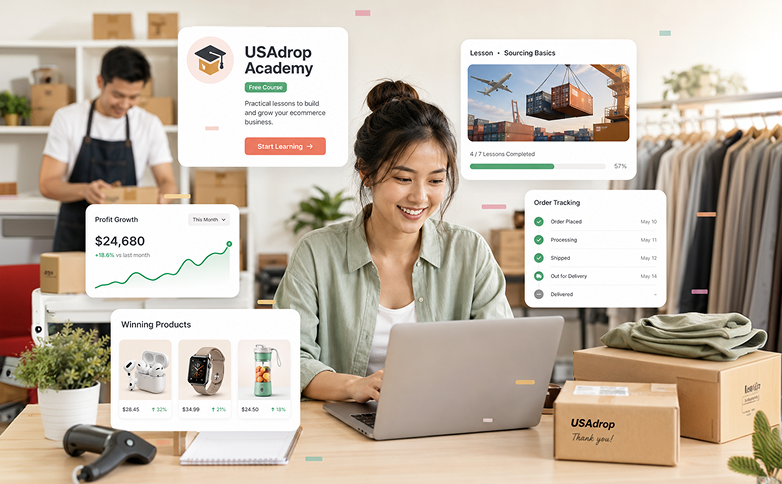
The main advantages of using a dropshipping supplier are that you pay for each product when an order comes in instead of buying stock in bulk, you don’t run a warehouse or a packing team, and you can add or drop products in days. You also use the supplier’s sourcing, inspection and shipping network instead of building your own.
They hold only when the supplier is reliable, and ad spend, refunds and cash flow stay with you.
7 Advantages of Using a Dropshipping Supplier
A dropshipping supplier sources or stocks the products, packs each order and ships it straight to your customer, so your cash goes into marketing instead of inventory. If you’re still testing demand, that’s the better trade: you skip warehouse rent, packing labor and the risk of units nobody buys.
1. No bulk inventory to buy before you sell
Buying inventory means paying for it before it sells. Illustrative math: 300 units at $8 each ties up $2,400 up front, while dropshipping the same item costs $8 per order plus handling and shipping, paid as orders arrive.
You still need working capital: at USAdrop you see the final shipping fee and pay when you confirm each order, while your payment provider can take several business days to release the customer’s money. Keep cash for supplier payments, ads and refunds during that gap.
2. No warehouse, packing staff or carrier contracts
The supplier handles the physical steps:
- Receiving and storing goods
- Picking and packing each order
- Choosing the carrier and handing over the parcel
- Uploading the tracking number
At USAdrop, orders are processed in 1–3 business days before they ship. That processing time belongs in your delivery promise, next to the transit time.
3. A wider catalog to test from
You can list a product, run a small test and remove it if it doesn’t sell, with no boxes left over. USAdrop works with 10,000+ partner factories and lists 1M+ products, so a second variant or related item doesn’t need a new supplier search. How many products you test is a budget call, since each needs its own sample, creative and ad spend.
4. A shared warehouse and shipping network
A small store can get discounted carrier rates or rent space from an overseas 3PL, but each account, contract and stock transfer is another thing to manage. A supplier with its own network spreads that setup across many sellers and negotiates on the combined volume. USAdrop runs 17 warehouses, 2 in China and 15 international. After processing, China-to-US delivery is estimated at 6–13 days, and products already stocked in a US or overseas warehouse are estimated at 2–5 days on eligible routes. Some destinations take longer, so confirm the estimate for the countries you sell to.
5. Quality checks before the parcel leaves
A supplier that inspects items before dispatch can catch wrong colors, missing parts and crushed packaging before your customer does. Inspection only works against a standard, so give the supplier one for each SKU:
- Approved photos of the product and packaging
- Dimensions, materials and color
- Every part that belongs in the box
- Packing and labeling rules
6. Branding without your own factory deals
Once a product sells, a supplier can add custom packaging, branded inserts or a private label, and some also run print on demand. USAdrop offers all four through its private customization service, so a store can move from generic listings to its own brand without switching suppliers. Ask about minimums and lead times first.
7. Order syncing, tracking and a named contact
Store integrations send each order to the supplier and push tracking numbers back to your store. USAdrop has one-click integration with Shopify and TikTok Shop, so once products and variants are mapped, orders reach fulfillment without manual entry. Check sync exceptions daily, because unmapped SKUs and address errors still need a person. Sellers with 5+ orders also get a dedicated agent.
Syncing orders doesn’t mean a route meets TikTok Shop’s deadlines. Its US fulfillment policy currently requires regular orders to reach In Transit within 2 business days and Delivered within 6 business days of Awaiting Shipment, with different clocks for pre-orders and made-to-order items. Our general processing and transit estimates don’t automatically fit those limits, so check your order type and shipping route against the current policy before you list.
Dropshipping Supplier vs. Buying Your Own Stock
For a new store, the alternative is buying wholesale stock and shipping it yourself or through a third-party logistics (3PL) warehouse.
| Factor | Dropshipping supplier | Own stock, self-shipped | Own stock + 3PL |
|---|---|---|---|
| Cash before first sale | Paid per order | Full stock purchase | Stock plus setup fees |
| Product purchase price | Typically higher per unit | Often lower with bulk buys | Often lower with bulk buys |
| Fulfillment cost | Handling fees plus shipping | Your time, packaging, postage | Pick, pack, storage, shipping fees |
| Your daily work | Marketing and support | Packing, shipping, support | Marketing, support, restocking |
| Delivery speed | Depends on stock location | Fast if domestic | Fast if domestic |
| If the product flops | No unsold stock; ad spend lost | Unsold stock | Unsold stock plus storage |
Bulk buying can lower the purchase price once a product sells steadily, but storage and fulfillment fees decide whether the total cost per order actually drops. At that point a mix can make sense: dropship new products and stock the proven ones near their buyers. Our comparison of hybrid fulfillment platforms covers the tools for running both side by side.
What Stays With You When a Supplier Ships
The customer relationship stays with you, including:
- Customer service. Buyers contact you about late parcels and wrong items.
- Refunds and returns. You fund them, so agree in writing which errors the supplier covers.
- Delivery promises. Quote processing and transit time separately.
- Ad spend and margin. Acquisition can be one of the biggest costs per order, and the supplier doesn’t share it.
- Product compliance. Your duties depend on the product, the destination market and whether you count as the retailer, importer or manufacturer.
For US sales, the CPSC online sellers’ safety guide explains which product-safety checks apply. Ask the supplier for test reports and labels for your market; its willingness to ship doesn’t make an item compliant.
Compare Landed Cost, Not the Product Price
A cheap product price can hide expensive shipping, handling or import charges. Ask each supplier to quote the parts separately, and confirm who pays each one:
- Product cost and handling
- Packaging and any branding
- Shipping to your main destination, with the parcel weight used
- Duties, tariffs, clearance fees and import taxes, and whether shipping includes them
- Storage, if stock sits in a warehouse
Duty rules for low-value parcels have changed in several markets, so recheck duty treatment for each route instead of relying on an old quote.
Illustrative example, not a supplier quote: a $35 order with an $11 product, $6 shipping with duties included, $1 in packing and payment fees, $8 in ad cost and a $2 refund allowance leaves $7 before overhead and income tax. If ad cost climbs to $12, you keep $3. Our dropshipping profit margin guide shows how to build that cost sheet for each product.
How to Check a Supplier Before You Scale
- Confirm and order the exact variant customers will get. Ask whether the supplier keeps that variant in stock or sources it after each order, since sourcing adds time before dispatch. Then check size, finish, packaging and instructions against your listing.
- Time processing and transit separately. Ship a sample to a typical customer address and note the dispatch and delivery dates.
- Get a written cost breakdown. Include every line above, plus the quote’s expiry date.
- Agree who pays for errors. For a wrong item, damage or a lost parcel, confirm the proof required and the response time.
- Run a small batch through the integration. Confirm that orders sync, tracking returns to your store and stock levels update.
- Test response speed. Send a real request, such as a variant swap, and see how long a clear answer takes.
If you’re comparing several options, our list of the best dropshipping suppliers sets out what each one covers.
When a Dropshipping Supplier Is the Wrong Choice
Supplier fulfillment suits products that are light, durable and easy to describe. It fits poorly when:
- The product needs certificates or test reports the supplier can’t provide.
- Items are bulky or fragile, so shipping cost or breakage wipes out the margin.
- Buyers of a high-ticket product expect fast delivery, premium unboxing and setup help.
- A proven bestseller has steady demand, and buying stock would cut its total cost per order.
In that case you can keep the supplier and stock the bestseller in a warehouse near your buyers, where those units can ship on the 2–5 day estimate if your destination is covered. Weigh that against the cash tied up and storage fees, using a written scorecard for each dropship vendor.
FAQ
What does a dropshipping supplier do?
A dropshipping supplier sources or stocks products, receives your store’s orders, and packs and ships them directly to your customers. Some also inspect items, sync tracking to your store and offer branded packaging.
Is a dropshipping supplier better than wholesale?
For testing products and keeping cash free, yes. For proven products with steady sales, wholesale stock can lower the total cost per order, so some stores use both.
How do I know a supplier is reliable?
Order samples of the exact variant, time processing and transit separately, and run a small batch of real orders. Reliable suppliers put costs in writing and have a clear process for wrong or damaged items.
Can a dropshipping supplier ship under my brand?
Yes, if the supplier offers it. Blind shipping removes supplier details from the parcel, while custom packaging, branded inserts or private label add your brand, so check minimums and lead times first.
Start with one product and one supplier, size the first batch of orders to your budget, and treat it as a test of the supplier as much as the product. If processing, tracking and error handling hold up, add products; if not, you’ve found out before buying inventory, though the test’s ad spend and refunds still count. With USAdrop, you can order a sample first, then connect your Shopify or TikTok Shop store and run that first batch.