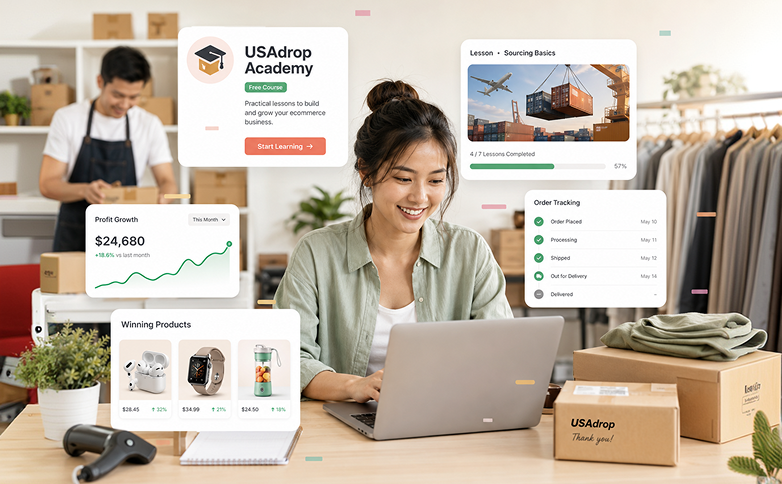
The pros and cons of dropshipping break down to this: you get low startup costs, location freedom, and zero inventory risk — but you trade away margin control, shipping speed, and product quality oversight. Whether that tradeoff works depends entirely on your goals, your budget, and how much operational headache you’re willing to tolerate.
Quick answer: This page is the pros and cons hub. It should frame whether the business model fits, while related pages handle profitability and worth-it math.
Related USAdrop resources: is dropshipping worth it, and does dropshipping make money.
If you’ve been researching how much money you need to start dropshipping, you’ve probably noticed the barrier to entry is shockingly low compared to traditional retail. A few hundred dollars can get you live. But “easy to start” and “easy to succeed at” are two very different things, and that gap is where most beginners get burned.
This article won’t sell you a dream. We’ll walk through every major advantage and disadvantage — with real numbers, named platforms, and actual scenarios — so you can decide whether dropshipping fits your situation in 2026. And where a disadvantage has a fix, we’ll tell you what it is.
The 7 Real Pros
1. Almost zero inventory risk.

Traditional e-commerce means buying 500 units of a product you hope will sell. If it doesn’t? You’re sitting on dead stock, eating storage fees, maybe liquidating at 30 cents on the dollar. Dropshipping flips that: you list a product, a customer orders it, and only then does your supplier ship it. You never touch inventory.
This matters more than people realize. According to the U.S. Small Business Administration, inventory mismanagement is one of the top reasons small retail businesses fail within five years. Dropshipping sidesteps that entirely.
2. Startup costs that don’t require a loan.
A Shopify Basic plan runs $39/month. A domain costs $10-15/year. You can test products with $200-500 in ad spend. Compare that to opening a retail store (average $50,000+ in initial investment, per Shopify’s 2024 Commerce Report) or even launching a traditional e-commerce brand with $5,000-15,000 in initial inventory purchases.
The math is simple: lower financial risk means you can test more ideas.
3. You can sell from anywhere with Wi-Fi.
Bali, your parents’ basement, a coffee shop in Denver. Your physical location is irrelevant to operations. This isn’t just a lifestyle perk — it’s a structural advantage. You can hire virtual assistants in different time zones, serve customers across multiple regions, and scale without ever signing a commercial lease.
4. Product testing happens at the speed of listing.
Want to test whether a portable neck massager sells better than a posture corrector? List both on Monday. Run $50 in Facebook ads to each by Wednesday. Kill the loser by Friday. In traditional retail, that same test would take weeks of purchase orders, shipping, and warehouse receiving.
5. Scaling doesn’t require proportional infrastructure growth.
When a traditional e-commerce brand goes from 100 orders/month to 1,000, they need more warehouse space, more packing staff, and bigger purchase orders (with bigger cash outlays). When a dropshipper scales the same way, the fulfillment burden stays with the supplier. Your job stays the same: marketing and customer service.
6. Massive product catalog flexibility.
You’re not locked into a niche by what you’ve already purchased. A store can list 50 products across different categories and narrow down based on actual sales data. Brands like Meowingtons (cat-themed products) started this way — testing dozens of items before doubling down on what worked.
7. Lower ongoing overhead.
No warehouse rent. No packing materials. No fulfillment staff. Your monthly fixed costs can stay under $200 until you’re generating meaningful revenue. That’s a luxury most business models don’t offer.
| Advantage | Traditional E-Commerce | Dropshipping |
|---|---|---|
| Startup cost | $5,000–$50,000+ | $100–$500 |
| Inventory risk | High | None |
| Time to first sale | 2–8 weeks | 24–72 hours |
| Product testing speed | Slow (weeks) | Fast (days) |
| Scaling infrastructure | Proportional growth needed | Minimal changes |
| Location dependence | Usually tied to warehouse | Fully remote |
The 7 Real Cons
Here’s where the conversation gets honest. The pros and cons of dropshipping aren’t balanced — the cons are heavier than most “start your store today!” content lets on.

1. Thin margins that punish sloppy math.
Typical dropshipping margins range from 15-30%, compared to 50-65% for private-label brands. On a $30 product, you might net $5-7 after product cost, shipping, and transaction fees. Now subtract your ad cost per acquisition — which, on Meta in 2025, averages $18-25 for cold traffic in competitive niches (according to Varos advertising benchmarks).
See the problem? You need either a very high conversion rate, a very low CPA, or a higher average order value to make the numbers work. Most beginners discover this after they’ve already spent their test budget.
One way to improve margins: work with suppliers who offer bulk-style pricing even on single-unit fulfillment. We built USADROP’s pricing model specifically around this — our members get 8.66% lower product costs on average compared to standard AliExpress pricing, which on thin-margin products can be the difference between profit and loss.
2. Shipping times that kill repeat purchases.
If your supplier ships from Shenzhen, your US customer waits 12-25 days. They ordered on impulse. By day 8, they’ve forgotten what they bought. By day 15, they’re filing a PayPal dispute.
This was the #1 dropshipping killer in 2020-2023. It’s gotten better — but only if you use suppliers with domestic warehouses. A dropshipping platform with US-based fulfillment centers can cut delivery to 2-5 days, which changes the entire customer experience equation.
At USADROP, we operate 18 warehouses globally, including multiple US locations. That’s not a flex — it’s a direct answer to the shipping-time problem that destroys most dropshipping stores.
3. Zero quality control (unless you build it in).
You’ve never held the product. You’ve never tested the packaging. You’re trusting a supplier’s QC process — and if you’re sourcing from random AliExpress vendors, that process might not exist.
A real scenario: A dropshipper lists a “premium leather wallet” based on listing photos. The supplier ships a synthetic pleather wallet that smells like chemicals. The customer leaves a 1-star review and initiates a chargeback. The store owner loses the product cost, the shipping cost, AND the chargeback fee ($15-25 per incident on Stripe).
The fix is working with fulfillment partners who do pre-shipment quality checks. Not all of them do. Ask directly. If they dodge the question, that’s your answer.
4. Brutal competition on identical products.
If you can list a product, so can 4,000 other stores. When everyone sells the same viral TikTok gadget from the same supplier, the only differentiator becomes price — and price wars on thin margins are a race to the bottom.
This is why successful dropshippers in 2026 are moving toward branded packaging, custom product bundles, and supplier-exclusive items. Commodity products still work for testing, but building a business on them long-term? Rough.
5. Customer service nightmares you can’t prevent.
Wrong item shipped. Package lost by the carrier. Supplier sent to the wrong address. None of these were your fault, but every one of them is your problem. You’re the face the customer sees.
The worst part: you can’t fix it fast. You submit a ticket to your supplier. They respond in 12-48 hours (if they respond at all). Meanwhile, your customer is fuming. This is where working with a responsive fulfillment partner — one that assigns dedicated support — becomes non-negotiable.
6. Platform dependency and account risk.
Build your entire business on Facebook ads? One policy change or account ban and your revenue drops to zero overnight. This happened at scale in 2023 when Meta’s AI moderation system flagged thousands of legitimate dropshipping ad accounts for “misleading practices.”
The lesson: diversify traffic sources early. SEO, email, organic TikTok, Google Shopping — don’t put every dollar into one channel.
7. Legal and tax complexity that surprises new sellers.
Nexus laws. Sales tax collection. Consumer protection compliance for returns. Product liability if someone gets hurt using what you sold. Most dropshippers operate as if these don’t apply to them. They do.
In 2024, the state of California alone initiated enforcement actions against 200+ e-commerce sellers for sales tax non-compliance, per the California Department of Tax and Fee Administration. If you’re selling to US customers, you need a sales tax solution (TaxJar, Avalara) from day one.
Who Dropshipping Works For
Not everyone.

Dropshipping works exceptionally well for three types of people:
Testers and validators. You have a product idea or niche hypothesis. Rather than investing $10,000 in inventory, you use dropshipping to prove demand first. If the product sells, you transition to bulk purchasing or private label. If it doesn’t, you lost $300 in ads instead of $10,000 in dead stock.
Side-hustlers with limited capital. You have a full-time job and $500 to invest. You want to build something on evenings and weekends. Dropshipping’s low overhead means you don’t need to quit your job to start, and the fulfillment is handled by your supplier.
Marketers who are better at selling than sourcing. If your skill set is Facebook ads, TikTok content, or SEO — and you’d rather not deal with warehouses, packaging, and supply chain logistics — dropshipping lets you focus entirely on what you’re good at.
Where dropshipping does NOT work well: products requiring customization at scale, perishable goods (obviously), high-ticket items where customers expect a premium unboxing experience, and any category where shipping speed under 2 days is table stakes (Amazon Prime has trained consumers to expect this).
If you’re curious about what is dropshipping at a more fundamental level, that guide covers the operational mechanics in detail.
Solving the Biggest Cons
Every con listed above has a mitigation strategy. Here’s what actually works in 2026 — not theory, but operational fixes.
Thin margins → Lower supplier costs + higher AOV. Work with a fulfillment partner that offers competitive product pricing (USADROP’s pricing runs 8.66% below standard marketplace rates on average). Pair that with upsells, bundles, and a $35+ free-shipping threshold to push average order value up. A store selling a $25 main product with a $12 upsell at 40% attachment rate sees a 19% boost in per-order profit.
Slow shipping → Domestic warehousing. If you’re selling to US customers, your inventory (or your supplier’s inventory) needs to be in the US. Period. USADROP’s US warehouse network gets most orders delivered in 2-5 business days. That’s the difference between a one-star review and a repeat customer.
No quality control → Pre-shipment inspection. Before committing to a supplier for more than test quantities, order 5-10 samples yourself. Inspect them. Use them. Then ask your fulfillment partner about their QC process. At USADROP, we inspect products before they ship — but I’d tell you to verify that with any partner you choose, including us. Trust, but verify.
Competition → Brand differentiation. Custom packaging inserts, branded thank-you cards, unique product bundles, and a real brand story. A store called “BestDealsShop2026” selling the same phone case as everyone else will always lose. A store called “Caseology Collective” with consistent branding, a social media presence, and curated product selections can charge 30% more for functionally identical products.
Customer service delays → Dedicated fulfillment support. Solo operators trying to manage supplier communication across a 12-hour time zone difference will burn out. A dropshipping business that uses a fulfillment partner with dedicated account reps (not just a ticket system) resolves issues 60-70% faster.
Here’s the thing nobody tells you: the best dropshipping operators in 2026 don’t look like dropshippers at all. Their stores look like real brands. Their shipping times compete with DTC brands. Their packaging is custom. The only operational difference is they don’t own a warehouse — they use someone else’s. That’s the model worth building.
2026 Trends Shifting the Balance
The pros and cons of dropshipping aren’t static. The model in 2026 looks different from 2020 in ways that matter.
AI-powered product research is leveling up speed. Tools like Minea, PiPiADS, and even ChatGPT-powered trend analysis are compressing the product research cycle from weeks to hours. This makes the “fast testing” advantage of dropshipping even more potent — but it also means your competitors find winning products just as quickly.
TikTok Shop is changing distribution. In 2025, TikTok Shop processed over $20 billion in global GMV (according to a Reuters report from January 2025). Dropshippers who create short-form content around their products — rather than relying exclusively on paid ads — are seeing customer acquisition costs 40-60% lower than Meta-only strategies.
Consumer expectations for shipping speed have permanently ratcheted up. Amazon’s same-day and next-day delivery has made 7-day shipping feel slow. Any dropshipping operation without a domestic fulfillment option is fighting an uphill battle on customer satisfaction.
USADROP launched its 24-hour store launch program specifically because speed matters on both ends — getting your store live fast, and getting orders to customers fast.
Returns are the hidden margin killer. The National Retail Federation reported that e-commerce return rates hit 17.6% in 2024. For dropshippers, returns are especially painful because reverse logistics with overseas suppliers is often impractical. Having a US-based fulfillment partner who handles returns domestically makes this manageable.
FAQ
Is dropshipping still profitable in 2026?
Yes, but margins are tighter than in 2019-2020. Successful dropshippers in 2026 typically earn 15-30% net margins by using domestic fulfillment, building real brands, and diversifying beyond paid social ads.
What’s the biggest risk of dropshipping?
Supplier reliability. A bad supplier means wrong items, slow shipping, and quality problems — all of which land on you. Vetting suppliers thoroughly (or using a fulfillment partner like USADROP) reduces this risk significantly.
Can you dropship on Amazon?
Yes, but Amazon’s dropshipping policy requires that you are the seller of record and that all packaging identifies you (not a third-party supplier). Violating this gets your account suspended.
How long until a dropshipping store makes money?
Most stores take 2-4 months of active testing and optimization before hitting consistent profitability. Stores that launch with proven products and domestic shipping can break even faster.
Do I need an LLC to start dropshipping?
You don’t legally need one to start, but forming an LLC ($50-500 depending on your state) protects your personal assets and makes you look legitimate to payment processors and suppliers.
Ready to test whether dropshipping fits your goals without the usual headaches? USADROP gives you access to 18 global warehouses, pre-vetted suppliers, 8.66% lower pricing, and a store that can go live within 24 hours. Over 80 million orders fulfilled across 10+ years — we’ve seen what works and what doesn’t. Start with a USADROP membership and find out whether the pros outweigh the cons for your specific business.