Jewelry dropshipping lets you sell necklaces, rings, bracelets, earrings, and other accessories without buying stock before you make a sale. You run the storefront and own the customer relationship. A supplier stores the products, prepares each order, and ships it to your buyer.
That sounds simple. The hard part is everything the customer can’t see: metal claims, finish quality, packaging, stock accuracy, delivery speed, and returns. In 2026, a winning jewelry store isn’t just a catalog connected to a supplier. It’s a focused brand backed by a dependable fulfillment system.
At USAdrop, we see the model as a way to test products with less inventory risk, then put more money behind the pieces customers already want. Here’s how the full process works and where your attention pays off.
How does jewelry dropshipping work?
Jewelry dropshipping works through a seven-step order flow:
- You choose a niche and source jewelry from a supplier.
- You import or create product listings in your online store.
- A customer pays the retail price at checkout.
- The order is sent to your supplier manually or through an integration.
- You pay the product, packaging, shipping, and service costs.
- The supplier inspects, packs, and ships the order directly to the customer.
- You send tracking updates and handle questions, refunds, and replacements.
You don’t normally touch the product. You do control what the customer sees and what you promise. That makes jewelry dropshipping closer to running a retail brand with outsourced operations than earning a passive commission.
| Party | Main responsibility |
|---|---|
| Store owner | Product selection, listings, pricing, marketing, customer service, and refunds |
| Supplier | Product availability, specifications, picking, and production where applicable |
| Fulfillment partner | Quality checks, packing, shipping, and tracking |
| Customer | Pays your store and contacts your store when something goes wrong |
Some suppliers perform all supplier and fulfillment tasks. Others only manufacture the item, leaving you to arrange inspection, storage, packaging, and delivery through a separate partner.
What makes jewelry dropshipping different in 2026?
The mechanics haven’t changed much. The standard expected from the seller has.
Jewelry is a trust-heavy category. A buyer can’t feel the chain weight, test the clasp, compare the photo with the plating color, or check the stone setting before checkout. Your listing has to carry that uncertainty.
Material language also needs care. The Federal Trade Commission’s Jewelry Guides say marketers should truthfully represent details such as metallic content, gemstone type, treatments, quality, size, weight, origin, and manufacturing. If a supplier calls a ring “silver,” your job isn’t done. You need to know whether it is sterling silver, silver-plated base metal, or simply silver-colored.
That creates four practical priorities for a jewelry dropshipping store:
- Exact specifications instead of vague material labels
- Samples and repeatable inspection standards before advertising
- Delivery and return terms that match the actual fulfillment route
- Original photos or approved supplier media that match the shipped item
Fast product importing is useful. Accurate product data is more important.
How to start a jewelry dropshipping business
1. Pick a narrow customer and product angle
“Jewelry” is too broad for a useful store promise. Choose a customer, use case, material, style, or price band that guides your buying decisions.
Possible angles include minimalist stainless-steel pieces for daily wear, birthstone gifts, travel-friendly jewelry organizers, personalized name necklaces, or coordinated bridesmaid sets. Each angle changes your sample tests, content, packaging, and supplier requirements. USAdrop’s broader list of products to dropship can help you compare jewelry with adjacent categories before you commit to a niche.
Be careful with claims such as “hypoallergenic,” “waterproof,” “solid gold,” “ethical,” or “handmade.” Treat each as a factual statement that needs documentation. If you can’t prove it, don’t put it on the product page.
2. Build a supplier shortlist
Start with two or three candidates rather than importing hundreds of items from the first catalog you find. Ask each supplier for information tied to specific SKUs:
- Base metal and surface material
- Plating method and, when available, plating thickness
- Stone type and whether it is natural, laboratory-created, or imitation
- Item dimensions, chain length, ring-size system, and weight
- Production or processing time
- Inventory update frequency
- Available shipping lines by destination
- Defect, replacement, and return process
- Neutral, white-label, or branded packaging options
A supplier who answers with product-level specifications is easier to manage than one who sends a generic assurance that every item is “high quality.”
3. Order samples before listing products
Buy the exact variants you plan to advertise. A gold-tone necklace and the silver-tone version may come from different batches or use different finishes.
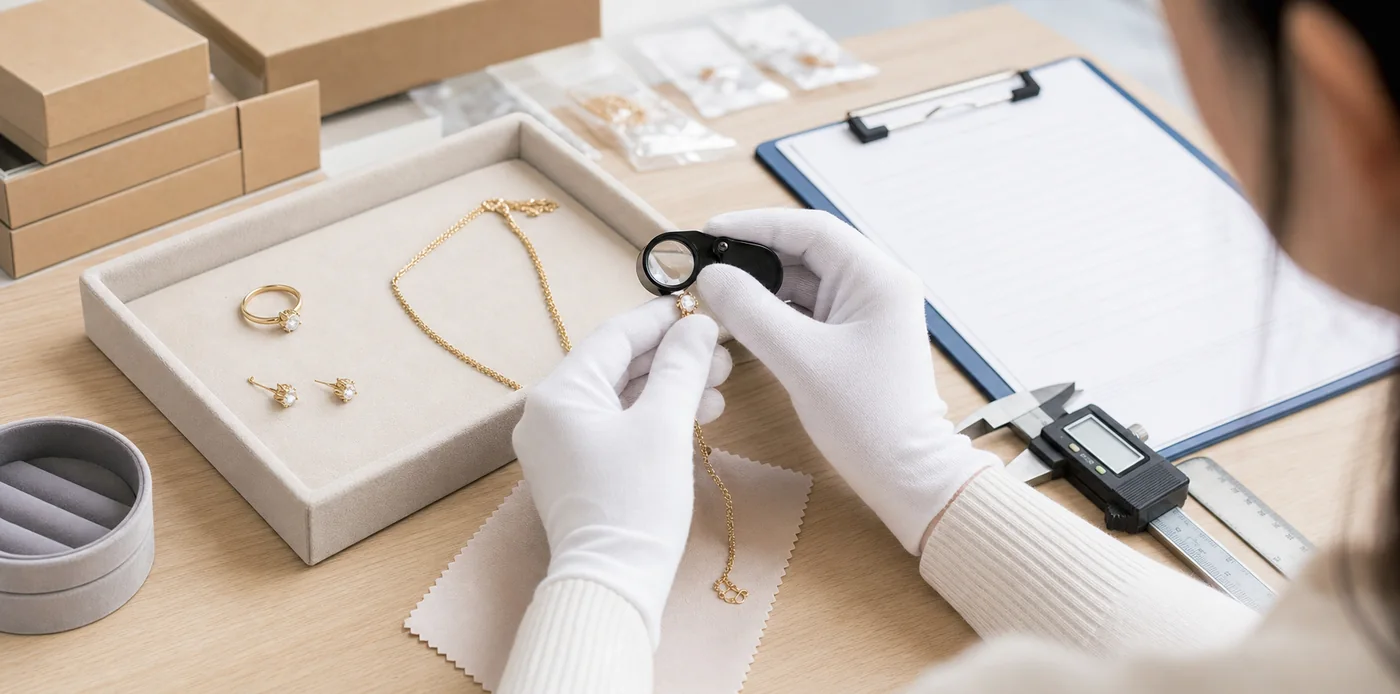
Inspect the sample in ordinary use, not only under a studio light:
- Compare its color, dimensions, and details with the listing assets.
- Open and close clasps, earring backs, and adjustable parts repeatedly.
- Check for sharp edges, loose stones, visible glue, scratches, and uneven plating.
- Wear-test relevant pieces and note any discoloration or irritation.
- Photograph the item on a person and beside a ruler or common object for scale.
- Pack and ship a sample to your target country to see the real unboxing result.
Keep an approved sample and a written specification sheet. That gives your supplier or fulfillment partner a reference when future batches arrive.
4. Calculate contribution profit per order
The difference between retail price and supplier price is not your profit.
Use this calculation:
Contribution profit = selling price − product cost − shipping − packaging − payment fees − platform fees − expected refunds/replacements − advertising cost
Imagine a necklace sells for $39:
| Cost item | Example amount |
|---|---|
| Product | $8.00 |
| Shipping | $5.50 |
| Packaging | $1.20 |
| Payment and platform fees | $2.00 |
| Refund/replacement reserve | $2.30 |
| Customer acquisition | $12.00 |
| Contribution profit | $8.00 |
The $31 retail-to-product spread looks generous. After the order-level costs, $8 remains to pay for software, labor, taxes, and business overhead. Replace the example amounts with a real quote for the SKU, destination, package size, and shipping method you plan to use.
5. Create listings from verified facts
Write a product page for the item the customer will receive, not for the supplier’s most flattering photograph.
Include:
- Material and finish
- Dimensions, weight, and sizing instructions
- What is included in the package
- Care instructions that match the material
- Processing and estimated delivery range
- Return and exchange conditions
- Clear close-up, scale, and worn images
Don’t copy a supplier title such as “Luxury 18K Gold Waterproof Diamond Necklace” unless every part of that description is supported. “18K gold-plated stainless steel necklace with cubic zirconia” tells the buyer far more and reduces avoidable disappointment.
6. Connect orders and set exception rules
Store integrations can pass order details to a fulfillment partner and return tracking data to the customer. Automation removes repetitive data entry; it doesn’t decide what to do when a size is unavailable or an address is incomplete.
Set rules for:
- Out-of-stock variants
- Address changes after payment
- Split shipments
- Orders held for suspected fraud
- Failed delivery attempts
- Damaged, incorrect, or missing items
- Personalized products that can’t be resold
Test the full journey with a real order. Confirm that the customer sees your store name, receives useful tracking, and doesn’t find an unknown supplier invoice in the package.
7. Launch a small collection and monitor it
Ten well-checked pieces are more manageable than 300 untested imports. Start with a small collection, then review cancellation reasons, support tickets, defects, transit time, delivery scans, and refund requests by SKU.
Pause a product when its actual quality or delivery performance no longer matches the listing. Ad performance can’t rescue a clasp that breaks or a ring that arrives in the wrong size.
Niche jewelry products worth testing in 2026
The strongest niche jewelry products combine a clear identity with simple fulfillment. Look for pieces that are lightweight, easy to demonstrate in short videos, giftable, and less dependent on precise sizing. Current trend evidence supports personalization, story-led charms, and playful statement pieces: Etsy reported an 84% increase for “whimsical jewelry” in its Spring and Summer 2026 trend report, while JCK’s 2026 trend coverage highlighted names, dates, symbols, letters, and birthstones.
These are product directions to validate, not guaranteed winners:
| Product niche | Why it can sell | What to verify before listing |
|---|---|---|
| Birth-flower and birthstone charm necklaces | Combines personalization with birthdays, Mother’s Day, anniversaries, and “just because” gifting | Stone description, flower accuracy, engraving preview, chain length, and personalization lead time |
| Modular story charm necklaces | Customers can build a piece around hobbies, pets, travel, family, or milestones; add-on charms can support repeat purchases | Charm attachment strength, metal consistency, compatibility, small-parts packaging, and photo accuracy |
| Whimsical micro-charm earrings | Food, marine-life, celestial, bookish, and hobby motifs give a store a clear visual identity and work well in short-form creative | Earring-post material, pair consistency, sharp edges, weight, and any allergy-related claims |
| Symbolic cord pendant necklaces | Adjustable cord sizing reduces fit friction, while zodiac, protective, botanical, and sculptural pendants create niche collection angles | Cord durability, knot or clasp strength, pendant weight, color transfer, and replacement components |
| Mixed-metal ear cuffs | No piercing requirement and limited sizing can make sampling simpler than rings while supporting a sculptural, mixed-metal collection angle | Grip consistency, comfort, coating durability, left/right orientation, and accurate worn photos |
Start with one audience and three to five related SKUs. A celestial collection, for example, could pair a moon ear cuff with a zodiac cord pendant and a birthstone charm. That is easier to position than mixing unrelated trend items in one storefront.
Treat personalized items as a separate operating lane. Confirm how spelling approvals, production cutoffs, cancellations, and defects work before accepting orders because a custom necklace usually can’t be returned to general inventory.
How do you choose a jewelry dropshipping supplier?
Choose a supplier by evidence at the SKU and shipping-route level. Catalog size matters less than repeatable product quality, clear specifications, inventory accuracy, and a written process for defective orders.
For a broader checklist, see USAdrop’s guide to finding a reliable jewelry dropshipping supplier, then compare catalog fit, sample standards, branding options, delivery routes, integrations, and return handling.
Use a scorecard so a low unit price doesn’t dominate the decision:
| Criterion | What to verify | Suggested weight |
|---|---|---|
| Product accuracy | Sample matches specifications and photos | 25% |
| Quality consistency | Written QC checks and batch reference process | 20% |
| Fulfillment | Processing time, tracking, and delivery by destination | 20% |
| After-sales | Defect evidence, replacement, refund, and return address | 15% |
| Integration | Order sync, inventory updates, and tracking sync | 10% |
| Branding | Neutral or custom packaging and insert options | 10% |
Ask for a quote that shows the product and shipping cost separately. The cheapest product may produce the most expensive delivered order if it needs slow shipping, oversized packaging, or frequent replacements.
What are the main risks?
Product descriptions can be wrong
Generic catalogs may repeat a manufacturer’s title without checking it. Require a specification sheet and match your listing language to the evidence you receive.
Quality can change between batches
An approved sample proves what you saw once. It doesn’t guarantee every future unit. Create measurable checkpoints for color, size, finish, component function, stone security, and packaging.
Shipping can erase the gift occasion
Jewelry is often purchased for a date: a birthday, anniversary, wedding, or holiday. Show a realistic delivery range and order-cutoff guidance. Don’t market a guaranteed arrival date unless your fulfillment route supports that promise.
Returns can become expensive
Decide where customers send returns before launch. A low-cost item shipped internationally may cost more to return than replace. Your policy should define the customer experience while your supplier agreement defines who absorbs the operational cost.
Branding can expose the original supplier
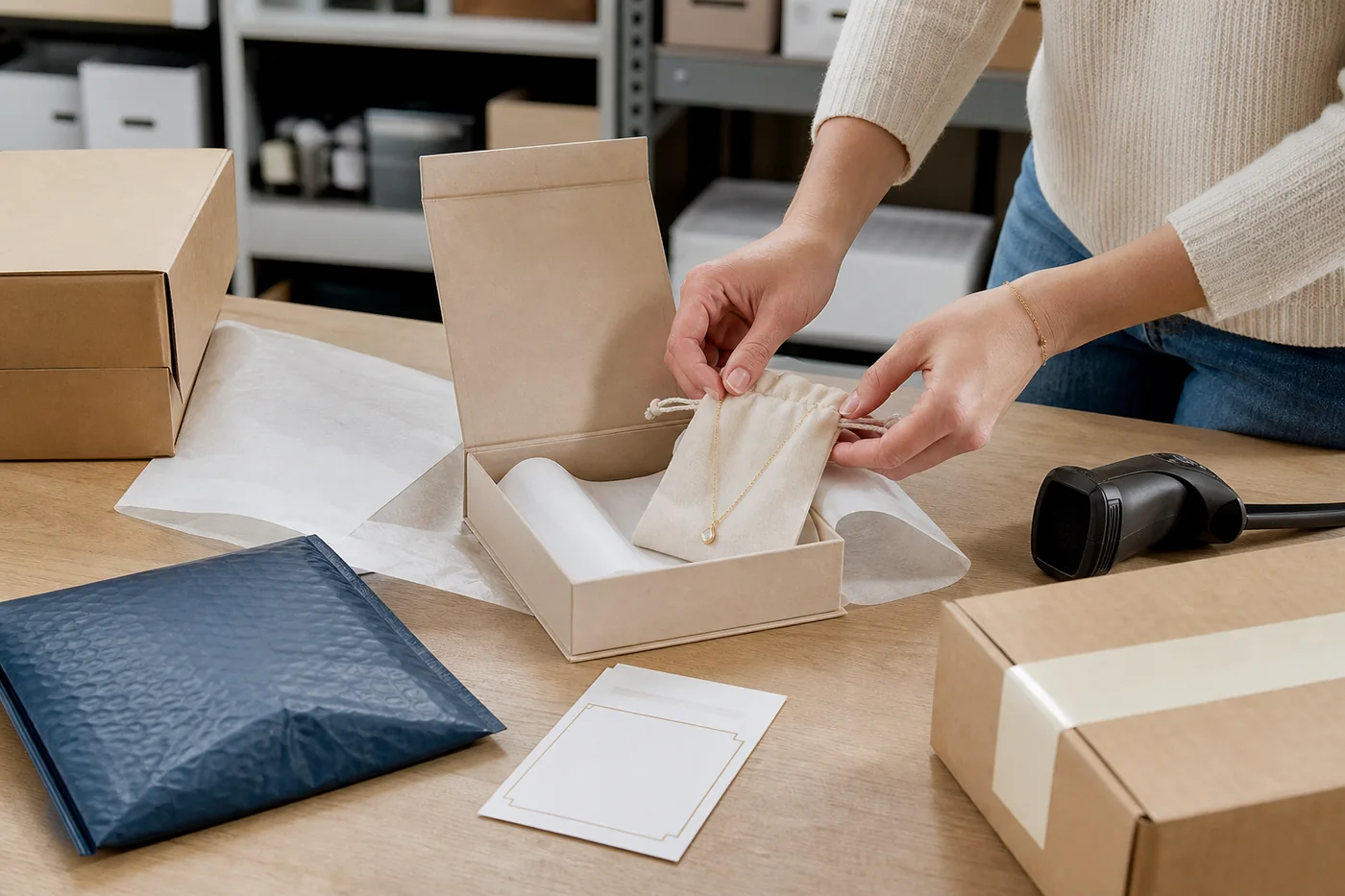
Neutral packaging is the minimum for a branded store. Once demand is stable, custom boxes, pouches, care cards, and thank-you inserts can improve the experience. Confirm minimum quantities, setup fees, lead time, storage cost, and how branded materials are assigned to orders.
For a wider operating view, compare these jewelry-specific risks with the biggest dropshipping challenges in 2026, including margin pressure, delivery expectations, and supplier dependence.
Jewelry dropshipping FAQ
Is jewelry dropshipping profitable?
It can be, but markup alone doesn’t prove profitability. Calculate product, shipping, packaging, platform, payment, advertising, and expected refund or replacement costs for each SKU and destination.
Do I need inventory?
You can start without buying finished-goods inventory. Samples are still necessary, and branded packaging or private-label production may require advance quantities or storage.
Can I use supplier photos?
Only with permission and only when the photos accurately represent the shipped item. Ordering samples and creating original scale, detail, and worn photos gives customers better information.
Who handles jewelry returns?
Your store handles the customer relationship. The supplier or fulfillment partner may receive or replace the item, but you need written rules for return addresses, evidence, deadlines, shipping costs, and personalized goods.
Can jewelry be private labeled?
Yes. Depending on the supplier, private-label options may include logos, modified designs, engraved pieces, branded pouches, boxes, care cards, and inserts. Confirm minimums and lead times before offering them.
Your next move
Pick three jewelry products and turn each one into a one-page sourcing brief: exact material, dimensions, target cost, destination, packaging, quality checks, and acceptable delivery range. Then request comparable quotes and samples.
Ask USAdrop for a product quote when you are ready to test the sourcing and fulfillment path with a real SKU.