Why can a dropshipping store look focused at first but still feel random when you start browsing it? This often happens when the store chooses a broad label—such as wellness, pets, or lifestyle—then fills it with products meant for completely different people. It is neither a flexible general store nor a focused niche brand. This guide explains why general niche dropshipping stores fail, when a broad test store still makes sense, and how to turn early product data into a store customers understand.
What General Niche Stores Get Wrong
The phrase “general niche store” sounds contradictory. Here, it means a hybrid store that claims one broad category but lacks a clear customer promise. A “home living” store may sell desk lamps, vegetable cutters, shower organizers, garden tools, and novelty signs. The products share a loose category, but they do not solve related problems for the same buyer.
That distinction matters. A category label tells shoppers where products belong. A niche promise tells them why the store is for them.
A category is not a customer promise
“Pet products” is a category. “Practical products for apartment cat owners” is a promise. The second version gives the owner a filter: a product belongs only if it helps the same person create the same kind of outcome.
General niche dropshipping stores fail when they use a category name as a substitute for positioning. The catalog keeps expanding because almost anything can fit the label. The homepage then has to speak to too many needs, while no single visitor feels fully understood.
Use the one-customer test
Before adding a product, ask: could the same customer reasonably buy this and at least two other products in the store within the next six months? If the answer is usually no, the catalog is a collection of separate micro-stores.
If you are still defining the audience, USAdrop’s guide to low-competition dropshipping niches shows how focused positioning can support clearer messaging and product selection.
Weak Positioning in General Niche Stores
A shopper should understand a store’s promise within seconds. Hybrid positioning makes that difficult because each product needs a different explanation.
Mixed products create mixed buying motives
Someone shopping for a posture cushion may care about daily comfort. Someone shopping for a novelty kitchen tool may want a quick gift. Someone shopping for a smart pet toy may want enrichment for a bored cat. Even if all three products are called “lifestyle essentials,” the purchase motives, objections, visuals, and language are different.
This causes every page to pull the brand in a new direction. The store may use one tone for wellness, another for gadgets, and another for gifts. Buyers notice the inconsistency even if they cannot name it. The site feels assembled rather than curated.
Broad promises are hard to prove
Claims such as “products that improve your life” or “the best finds for everyone” are easy to write but hard to support. They do not explain why this store selected these products or why a shopper should return.
A stronger general niche store makes a narrower promise and enforces it. For example, “compact upgrades for small home offices” can include lighting, cable control, desk storage, and ergonomic accessories because each item supports one setting and one customer.
Mixed Ad Signals Across General Niche Products
Paid advertising improves when campaigns receive consistent signals about who responds and what they want. A hybrid catalog makes that learning harder.
Every product attracts a different audience
If one campaign sells a dog car seat, another sells a skincare refrigerator, and another sells a camping light, the store is collecting three unrelated groups. Creative insights from one product may not help the next. A successful hook, audience segment, or remarketing message cannot be reused easily across the catalog.
This is one reason general niche dropshipping stores fail after an early winning-product test. They can generate individual sales but struggle to turn those sales into reusable customer knowledge.
Store-level remarketing becomes vague
Retargeting works best when visitors have related interests. A shopper who viewed a dog travel product may respond to seat covers, portable bowls, or walking accessories. That same shopper is less likely to care about a kitchen gadget simply because both items are “trending.”
Keep campaign reporting separated by customer problem, not only by product. Compare acquisition cost, conversion rate, and add-to-cart behavior at the category level. A repeated winner may reveal the niche your store should become.
Navigation Problems in General Niche Stores
Navigation is a promise about how a catalog is organized. When product logic is weak, menus and collections expose the problem.
Supplier categories do not match search intent
Menus such as “Home,” “Beauty,” “Pets,” and “Electronics” describe inventory, not shopping missions. They force visitors to search through broad groups instead of moving toward a clear outcome.
Organize a focused catalog around needs when possible: “Small-Space Storage,” “Calm Indoor Cats,” or “Desk Comfort.” These labels connect products through intent. They also help a store create useful collection pages instead of thin lists of unrelated items.
The homepage tries to explain everything
A general niche homepage often rotates through unrelated hero products. Each banner introduces a new audience, so the page never builds one convincing story. Product recommendations also feel arbitrary because the site cannot predict what “related” means.
Study USAdrop’s Shopify dropshipping store examples for a useful contrast: the strongest stores make the customer, visual identity, and reason to browse easy to recognize.
Repeat-Sales Barriers for General Niche Stores
The first order proves that a product can sell. It does not prove that the store can keep the customer. Hybrid stores often confuse product demand with brand demand.
Cross-sells feel unrelated
A good cross-sell completes a task or extends an outcome. A laptop stand can lead to cable organizers and desk lighting. A cat carrier can lead to travel bowls and seat protection. The connection is obvious.
In a mixed catalog, recommendations are based on what is available rather than what the buyer needs. Bundles become forced, average order value is harder to improve, and the checkout cannot make a helpful next suggestion.
Email campaigns split into tiny audiences
After the first sale, every product category needs its own content, offer, and product roadmap. A small store may not have enough buyers in each segment to support this work. Sending the same campaign to everyone reduces relevance; creating a separate campaign for every unrelated category multiplies the workload.
The solution is not simply fewer products. It is more product relationships. A focused catalog gives the owner several reasons to contact the same customer without changing the brand’s subject every week.
The Right Role for General Dropshipping Stores
A general store is not automatically a bad model. It can be useful as a controlled research environment before the owner has enough evidence to choose a niche.
Keep a general store for testing
Use a general test store when the goal is to compare a small number of product directions quickly. Give each direction its own landing page, creative set, tracking, and budget. Do not treat the test store as the final brand.
USAdrop’s monthly trending products guide makes a similar distinction: a broad store can test products, while a consistent performer can later support a focused niche store.
Set a decision point before testing. Review the evidence after a defined number of visits, purchases, or test cycles. The goal is to find a repeatable customer problem, not to keep adding products forever.
Keep a broad store only with a real organizing idea
Some multi-category stores work because a clear use case connects everything. A gift store can span categories if it organizes products by recipient, occasion, humor, or price. A small-space store can sell items from home, office, and pet categories if every product helps people live well in limited space.
The unifying idea must guide the catalog, navigation, creative, and follow-up marketing. A broad inventory alone is not a strategy.
A Practical General-to-Niche Store Transition
Do not choose a niche only because one product had one good day. Look for a pattern across customer behavior.
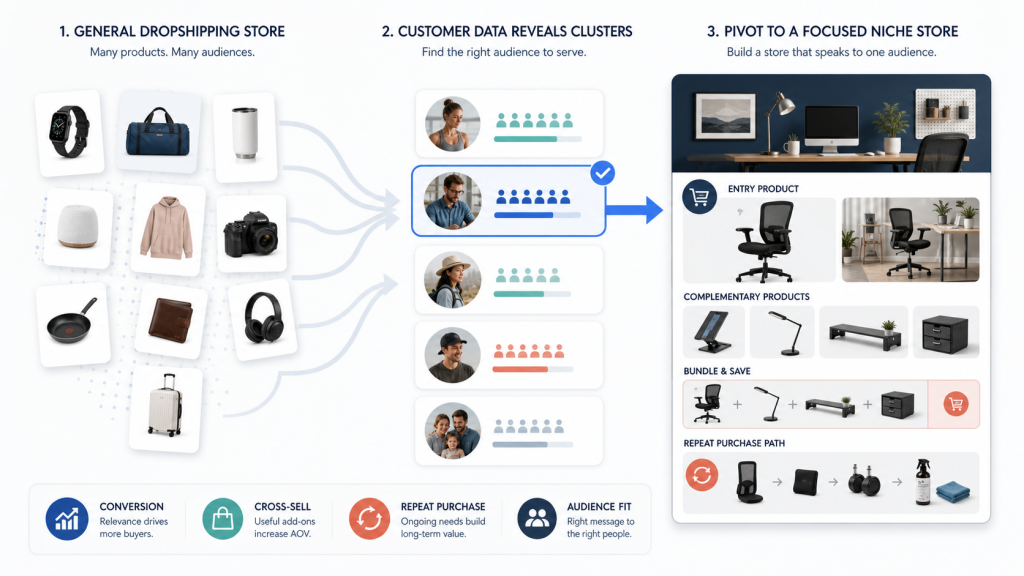
Find the strongest customer cluster
Group products by buyer problem and compare:
- conversion rate by product cluster;
- customer acquisition cost by audience;
- refund and return reasons by cluster;
- cross-sell acceptance;
- repeat purchases and returning-customer revenue;
- response to email or remarketing offers.
The best niche is usually the cluster with both acquisition potential and room for several related products. Remove weak categories gradually, redirect retired collection pages when appropriate, and update the homepage around the winning customer promise.
Build a connected product ladder
Start with an easy-to-understand entry product. Add complementary items, bundles, and higher-value versions that serve the same buyer. Then make the brand more memorable through consistent visuals and packaging. USAdrop’s private customization service supports product bundling, labeling, and personalized packaging once a store has validated the direction.
The answer to why general niche dropshipping stores fail is not “they sell too many products.” They fail when the products do not create one audience, one promise, or one learning system. A general store can discover demand. A focused store turns that demand into a brand.
General Niche Dropshipping Store FAQs
What is a general niche dropshipping store?
It is a hybrid store built around a broad category but filled with products for different buyers and purchase motives. It appears focused by name, yet behaves like several unrelated stores sharing one domain.
Are general dropshipping stores always bad?
No. A general store can be useful for controlled product testing or when one clear use case connects multiple categories. Problems begin when the owner keeps the broad test structure after customer data reveals a stronger niche.
How do I know when to switch to a niche store?
Switch when one customer problem consistently produces stronger conversion, acquisition, cross-sell, or repeat-purchase signals than the other product clusters. Confirm the pattern across several related products rather than relying on one short sales spike.
Should I delete unrelated products immediately?
Usually, no. Stop promoting weak categories first, preserve useful performance data, update navigation, and retire pages in stages. If an indexed page is removed, use an appropriate redirect to the closest relevant destination instead of creating a dead end.
Can one store serve more than one niche?
Yes, if the niches share a buyer, use case, or buying occasion. A store for apartment cat owners can sell travel, feeding, play, and cleaning products because the customer promise remains consistent.